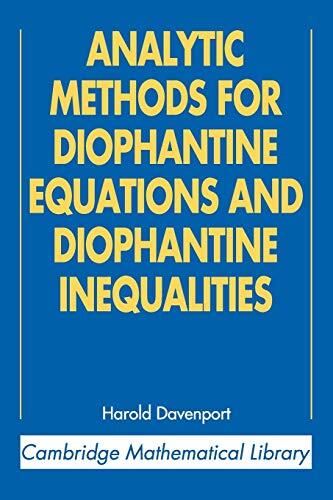
تفاصيل الكتاب
تنسيق
غلاف ورقي
صفحات
160
لغة
الإنجليزية
منشور
Feb 7, 2005
الناشر
Cambridge University Press
الطبعة
2nd Revised ed.
رقم ISBN-10
0521605830
رقم ISBN-13
9780521605830
الوصف
Harold Davenport's work stands as a significant contribution to the field of number theory, particularly through his exploration of Diophantine equations and inequalities. He brings a unique perspective, marrying deep theoretical insights with practical applications. Davenport's approach reflects his profound understanding of mathematical concepts, providing readers with an entryway into the intricate world of Diophantine analysis.
The text delves into various analytic methods that illuminate the behavior and properties of these equations. It offers a comprehensive look at techniques that have shaped the understanding of how integer solutions operate within given constraints. The richness of the material allows mathematicians and enthusiasts alike to appreciate the complexity and beauty of Diophantine problems.
Davenport's lectures serve as the foundation for this compilation, showcasing his ability to communicate complex ideas succinctly yet effectively. The clarity with which he presents the material stands as a testament to his skill as an educator and a mathematician.
Overall, this work not only highlights Davenport's legacy but also invites new generations to engage with the intriguing challenges presented by Diophantine equations and inequalities. It is an essential resource for anyone looking to deepen their grasp of this vital area of mathematics.
The text delves into various analytic methods that illuminate the behavior and properties of these equations. It offers a comprehensive look at techniques that have shaped the understanding of how integer solutions operate within given constraints. The richness of the material allows mathematicians and enthusiasts alike to appreciate the complexity and beauty of Diophantine problems.
Davenport's lectures serve as the foundation for this compilation, showcasing his ability to communicate complex ideas succinctly yet effectively. The clarity with which he presents the material stands as a testament to his skill as an educator and a mathematician.
Overall, this work not only highlights Davenport's legacy but also invites new generations to engage with the intriguing challenges presented by Diophantine equations and inequalities. It is an essential resource for anyone looking to deepen their grasp of this vital area of mathematics.

![A Course of Pure Mathematics - Godfrey Harold Hardy [World'S Best Edition]](https://images.bookpine.com/1c07f507-f966-482d-9ac4-eaca746155d2.jpg)