الوصف
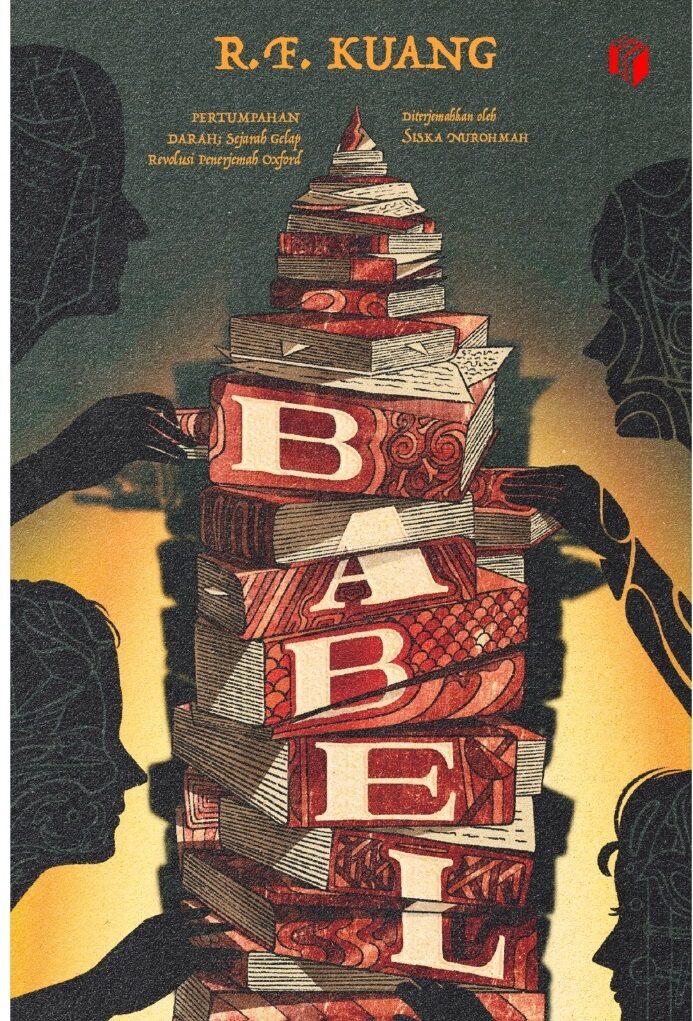
Babel adalah pusat penerjemahan dunia dan, yang lebih penting lagi, adanya cipta-perak: seni mewujudkan makna yang hilang dalam penerjemahan melalui batangan perak yang dipahat, dengan efek magis. Pengerjaan perak telah membuat Imperium Inggris memiliki kekuatan yang tak tertandingi. Penelitian Babel tentang penerjemahan membantu upaya Imperium untuk menjajah segala sesuatu yang ditemuinya.
Oxford, kota dengan menara-menara impian, adalah sebuah dongeng bagi Robin: sebuah komunitas utopia yang didedikasikan untuk mengejar pengetahuan. Namun, pengetahuan melayani kekuasaan, dan bagi Robin—seorang anak Tiongkok yang dibesarkan di Britania—mengabdi pada Babel berarti mengkhianati tanah leluhurnya.
Robin mendapati dirinya terjebak di antara Babel dan Perkumpulan Hermes, sebuah organisasi yang didedikasikan untuk menyabotase pekerjaan perak yang mendukung ekspansi Imperium. Ketika Britania mengejar perang yang tidak adil dengan Tiongkok untuk mendapatkan perak, dia harus memutuskan: Dapatkah institusi yang berkuasa diubah dari dalam, atau apakah revolusi selalu membutuhkan kekerasan?
تفاصيل الكتاب
المراجعات
عرض الكل
︎ ︎︎︎ ︎
📚 : Babel
★★★★★
welp. reading this as a language student makes me feel like i’m actually part of the book. what i know? translation is political. language is never just something neutral—it’s a currency, a tool, and eventually, a means of control. the silver-working system is such a clever metaphor for colonialism because it takes something that belongs to everyone and makes it valuable only when it is filtered through the empire. knowledge is collected, translated, institutionalized, and then used against the very people and cultures it was taken from. it’s not so far from every system, from the current system. this book just told the story of every nation suffering from the endless government corruption.
i understand robin. which from what i heard, not everybody does. yes, he made decisions that felt wrong, decisions that were literally wrong, decisions that felt selfish, decisions that came from his ignorance and his choice to stay ignorant. but robin is just like everyone else, he just unconsciously took a longer path to his awakening. he doesn’t enter oxford knowing exactly what he is participating in. he wants knowledge. he wants belonging. he wants to be good enough for the place that has given him a home. this is what the system does, not just to robin, the system doesn’t need you to believe in it completely. it only needs you to benefit from it enough to stay. hindi malayo sa totoong buhay, too close for comfort, actually. kasi sino bang hindi umikot sa sistema bago nagising? mahirap lumingon kapag nasa harap mo ang privilege. for someone who almost díed, who lost everything, who only has his self, it becomes harder to throw things away. kaya naiintindihan ko. i am not saying it’s okay to stay ignorant, i’m saying circumstances happen. and i think what matters more is the fact that he woke up and realized everything. and that when he realized, he chose the moral path (pinaparinggan ko si letty).
this isn’t romanticizing war, but i found it particularly absorbing that the war actually happened, just not in china. and it isn’t just armies and borders and governments. it is in academia. in who gets to speak. in whose language is considered sophisticated. in who gets to produce knowledge and who gets reduced to a source of it. oxford is terrifying because it looks so civilized while being built on exploitation. it’s also terrifying because the war happened throughout the book, and yet we only knew abt the war when the strike happened. it took someone speaking up illegally before people realized oxford is not as peaceful as it looks. it felt overwhelming, pero not the bad overwhelming. the good overwhelming. i liked how i understood everything, took everything to heart, and contemplated with everything while reading.
that said, i don’t think the book is flawless. there were moments when the explanations became so extensive that some parts became repetitive. i understand why it that way, tho. and honestly, the academic density is part of the book’s main point, but there were times when i wanted the characters to just breathe between the arguments. and i also felt somehow suffocated by the overload of knowledge, of power, of things to understand, of things to reflect upon, of all the things that happened. still, i think that’s also why babel stayed with me for quite a while. it doesn’t really want you to walk away simply thinking the book is done. it wants you to question the institutions you admire, the knowledge you consume, and the systems that determine whose knowledge gets preserved in the first place. it wants you to be uncomfortable.
as uncomfortable as robin in the story, as someone who’s not simply choosing between being a good or a bad person. he was choosing between belonging to a system that had given him everything and destroying that same system because he finally understood what it had taken from everyone else.
as uncomfortable as letty, as a woman in a world that constantly reminds her that she is less powerful than the men around her, and yet a woman still capable of benefiting from a system that oppresses other people. her own struggles do not automatically make her understand the struggles of robin, ramy, or victoire. which reminds us that being marginalized does not automatically make someone incapable of becoming complicit in another person’s marginalization. genuinely believing you can find freedom within the system rather than questioning the system itself. wanting to succeed in a world that has already decided what women are allowed to be. the desire to belong eventually becomes willingness to protect the very institution that excludes others. privilege can exist alongside oppression. you can be disadvantaged in one aspect of your life and still benefit from another hierarchy. suffering does not automatically make someone politically conscious. be uncomfortable.
babel is not really about whether language has power, because language has always had power. it is about who gets to own that power, and what happens when the people who built the empire’s language finally decide to speak against it. this is really a good book. i can say so much more. i’ve got a lot on my mind. i think everyone deserves to read this once in their lives.
︎ ︎︎︎ ︎

Maestoso, é la prima parola che mi viene in mente per descrivere la portata di questo romanzo. Babel è sicuramente la lettura più bella, profonda, toccante, ambiziosa e colta di quest’anno. All’interno troviamo temi spaventosamente attuali come: razzismo, discriminazione di genere, colonialismo, ricerca di d’identità, schiavismo, rivoluzione, appropriazione culturale e rapporto tra linguaggio e dominio…Sicuramente non una lettura semplice o leggera, ma necessaria soprattutto visti i tempi in cui viviamo.