

تفاصيل الكتاب
تنسيق
غلاف ورقي
صفحات
56
لغة
الفرنسية
منشور
Feb 28, 2018
الناشر
HACHETTE LIVRE-BNF
رقم ISBN-10
2012767958
رقم ISBN-13
9782012767959
الوصف
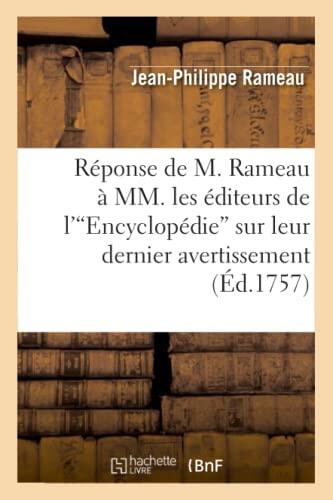
In the mid-18th century, the French Enlightenment was a vibrant period of intellectual discourse, and Jean Philippe Rameau found himself at the center of the storm surrounding the philosophical undertones of the time. His response to the editors of the esteemed Encyclopédie ignites a fascinating exploration of artistic integrity, musical theory, and the roles of composers within the broader cultural landscape.
Rameau's work serves as a critical dialogue, bargaining not only for the respectability of music as a serious art but also for the recognition of its foundational principles. Through eloquent arguments, he outlines his belief that music is a science that deeply intertwines with emotion and reason, providing insights that challenge prevailing notions of creativity and authority within the arts.
As an advocate for a nuanced understanding of music, Rameau urges for a thoughtful consideration of the symbiotic relationship between theory and practice. His intricate prose reflects his passion for composition and a desire to elevate the status of musicians among the learned classes.
The publication stands not just as a defense of Rameau's artistry, but as a broader commentary on the evolving landscape of cultural production during a time when the Enlightenment thinkers were reshaping Western thought. It beckons readers to engage with the complexities of artistic creation, drawing connections between music, philosophy, and society.
Rameau's work serves as a critical dialogue, bargaining not only for the respectability of music as a serious art but also for the recognition of its foundational principles. Through eloquent arguments, he outlines his belief that music is a science that deeply intertwines with emotion and reason, providing insights that challenge prevailing notions of creativity and authority within the arts.
As an advocate for a nuanced understanding of music, Rameau urges for a thoughtful consideration of the symbiotic relationship between theory and practice. His intricate prose reflects his passion for composition and a desire to elevate the status of musicians among the learned classes.
The publication stands not just as a defense of Rameau's artistry, but as a broader commentary on the evolving landscape of cultural production during a time when the Enlightenment thinkers were reshaping Western thought. It beckons readers to engage with the complexities of artistic creation, drawing connections between music, philosophy, and society.