

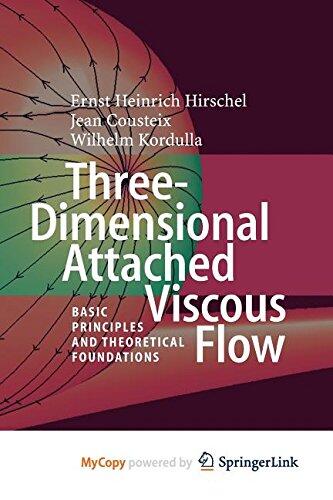
تفاصيل الكتاب
تنسيق
غلاف ورقي
صفحات
408
لغة
الإنجليزية
منشور
Oct 31, 2013
الناشر
Springer
رقم ISBN-10
364241379X
رقم ISBN-13
9783642413797
الوصف
Viscous flow is treated usually in the frame of boundary-layer theory and as two-dimensional flow. Books on boundary layers give at most the describing equations for three-dimensional boundary layers, and solutions often only for some special cases. This book provides basic principles and theoretical foundations regarding three-dimensional attached viscous flow. Emphasis is put on general three-dimensional attached viscous flows and not on three-dimensional boundary layers. This wider scope is necessary in view of the theoretical and practical problems to be mastered in practice. The topics are weak, strong, and global interaction, the locality principle, properties of three-dimensional viscous flow, thermal surface effects, characteristic properties, wall compatibility conditions, connections between inviscid and viscous flow, flow topology, quasi-one- and two-dimensional flows, laminar-turbulent transition and turbulence. Though the primary flight speed range is that of civil air transport vehicles, flows past other flying vehicles up to hypersonic speeds are also considered. Emphasis is put on general three-dimensional attached viscous flows and not on three-dimensional boundary layers, as this wider scope is necessary in view of the theoretical and practical problems that have to be overcome in practice. The specific topics covered include weak, strong, and global interaction; the locality principle; properties of three-dimensional viscous flows; thermal surface effects; characteristic properties; wall compatibility conditions; connections between inviscid and viscous flows; flow topology; quasi-one- and two-dimensional flows; laminar-turbulent transition; and turbulence. Detailed discussions of examples illustrate these topics and the relevant phenomena encountered in three-dimensional viscous flows. The full governing equations, reference-temperature relations for qualitative considerations and estimations of flow properties, and coordinates for fuselages and wings are also provided. Sample problems with solutions allow readers to test their understanding.