Beschreibung
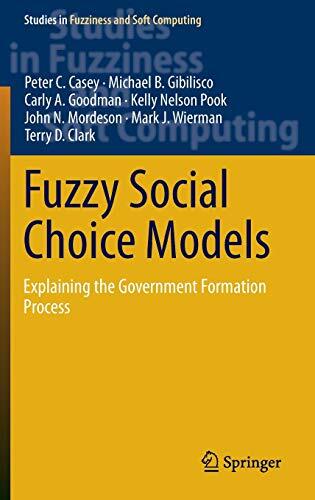
In this scholarly exploration of social choice theory, a team of researchers delves into the complexities surrounding the government formation process. Through the lens of fuzzy logic, they unpack the ambiguities and nuances inherent in political decision-making, offering a refreshing perspective on how governments are formed and the various factors that influence this process.
The authors intertwine mathematical rigor with political science, showcasing innovative fuzzy models that better capture the uncertainty and subjectivity of voter preferences. This multidimensional approach allows for a deeper understanding of how coalitions are formed and how power dynamics play out in a political context.
By integrating real-world case studies with theoretical frameworks, the work highlights the practical implications of fuzzy social choice models, demonstrating their significance not just in academics but in practical governance and policy-making. Readers are invited into a world where traditional binary choices are expanded, revealing the rich tapestry of social preferences that shape political landscapes.
Ultimately, this collective effort illuminates the critical need for adaptive models in a rapidly changing political environment, advocating for a more inclusive understanding of democracy that acknowledges the fuzziness of human choice.
The authors intertwine mathematical rigor with political science, showcasing innovative fuzzy models that better capture the uncertainty and subjectivity of voter preferences. This multidimensional approach allows for a deeper understanding of how coalitions are formed and how power dynamics play out in a political context.
By integrating real-world case studies with theoretical frameworks, the work highlights the practical implications of fuzzy social choice models, demonstrating their significance not just in academics but in practical governance and policy-making. Readers are invited into a world where traditional binary choices are expanded, revealing the rich tapestry of social preferences that shape political landscapes.
Ultimately, this collective effort illuminates the critical need for adaptive models in a rapidly changing political environment, advocating for a more inclusive understanding of democracy that acknowledges the fuzziness of human choice.
Buchdetails
Format
Gebundene Ausgabe
Seiten
196 Seiten
Sprache
Englisch
Veröffentlicht
Jul 8, 2014
Verlag
Springer
Ausgabe
2014
Ausgaben
4 editions
ISBN-10
3319082477
ISBN-13
9783319082479