

Beschreibung
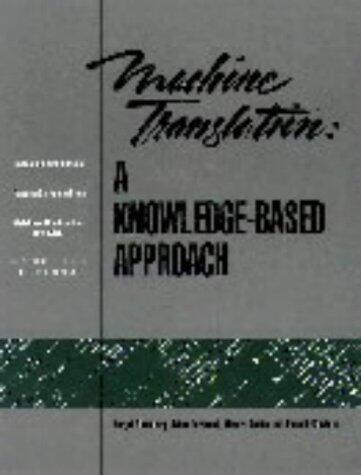
This is the first book devoted exclusively to knowledge-based machine translation. While most approaches to the machine translation for natural languages seek ways to translate source language texts into target language texts without full understanding of the text, knowledge-based machine translation is based on extracting and representing the meaning of the source text. It is scientifically the most challenging approach to the task of machine translation, and significant progress has been achieved within it in recent years.
The authors introduce the general paradigm of knowledge-based MT, survey major recent developments, compare it with other approaches and present a paradigmatic view of its component processes-natural language analysis, natural language generation, text meaning representation, ontological modeling, etc. Special chapters are devoted to machine-aided translation, speech translation, and challenges and solutions for knowledge representation. Based on these analyses, as well as on a review of general trends in MT, the authors discuss interesting directions for future research and development.
This book will be of interest to researchers and advanced students in machine translation, natural language processing, computational linguistics, artificial intelligence, and even to some philosophers of language and theoretical linguists.
The authors introduce the general paradigm of knowledge-based MT, survey major recent developments, compare it with other approaches and present a paradigmatic view of its component processes-natural language analysis, natural language generation, text meaning representation, ontological modeling, etc. Special chapters are devoted to machine-aided translation, speech translation, and challenges and solutions for knowledge representation. Based on these analyses, as well as on a review of general trends in MT, the authors discuss interesting directions for future research and development.
This book will be of interest to researchers and advanced students in machine translation, natural language processing, computational linguistics, artificial intelligence, and even to some philosophers of language and theoretical linguists.
Buchdetails
Format
Gebundene Ausgabe
Seiten
250 Seiten
Sprache
Englisch
Veröffentlicht
Jan 1, 1992
Verlag
Ap Professional
Ausgabe
n
ISBN-10
1558601287
ISBN-13
9781558601284