

Buchdetails
Format
Taschenbuch
Sprache
Englisch
Veröffentlicht
Sep 19, 2005
Verlag
Pen and Sword
ISBN-10
1844153029
ISBN-13
9781844153022
Beschreibung
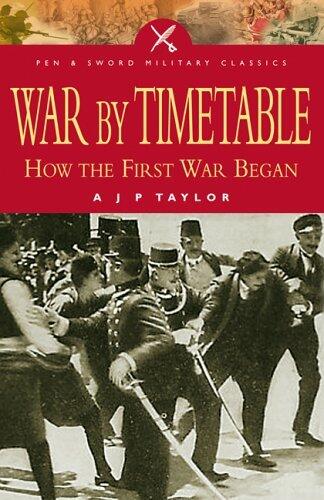
War by Time-table is a history of the mobilization of the armies of the Great Powers in 1914. AJP Taylor not only argues that the circumstances were already set for a general war, (he may state in the opening pages of his First World War that Europe of the early 1910s was a peaceful looking place, nevertheless he knew about the figures of industrial production, colonial expansion, and territorial demands of the era) he also names the specific flaw in the war plans of the Great Powers (especially Germany) that, when ignited, would make the war unavoidable.
All mobilization plans depended on railways. At that time the automobile was hardly used, certainly not as an instrument of mass transport, and railways demand time tables. All the mobilization plans had been timed to the minute, months or even years before and they could not be changed. Modification in one direction would ruin them in every other direction. Any attempt for instance by the Austrians to mobilize against Serbia would mean that they could not then mobilize against Russian because two lots of trains would be running against each other. The same problem was to arise later for the Russians and in the end for the Germans who, having a plan to mobilize against France, could not switch round and mobilize again against Russia. Any alteration in the mobilization plan meant not a delay for 24 hours but for at least six months before the next lot of timetables were ready.
This fascinating and controversial book is essential reading not just for historians of the First World War for all who are interested in the logistics of combat.
All mobilization plans depended on railways. At that time the automobile was hardly used, certainly not as an instrument of mass transport, and railways demand time tables. All the mobilization plans had been timed to the minute, months or even years before and they could not be changed. Modification in one direction would ruin them in every other direction. Any attempt for instance by the Austrians to mobilize against Serbia would mean that they could not then mobilize against Russian because two lots of trains would be running against each other. The same problem was to arise later for the Russians and in the end for the Germans who, having a plan to mobilize against France, could not switch round and mobilize again against Russia. Any alteration in the mobilization plan meant not a delay for 24 hours but for at least six months before the next lot of timetables were ready.
This fascinating and controversial book is essential reading not just for historians of the First World War for all who are interested in the logistics of combat.
Genres
Action & Abenteuer
Geschichte