

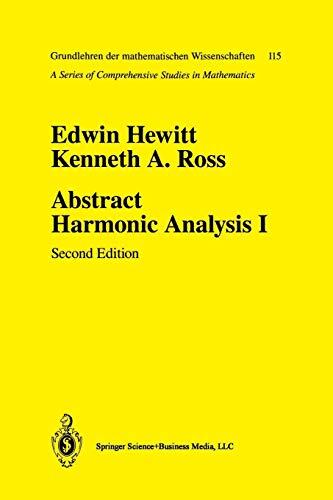
جزئیات کتاب
فرمت
جلد نرم
صفحات
534
زبان
انگلیسی
منتشر شده
Jan 7, 1994
ناشر
Springer
نسخه
2nd
ISBN-10
0387941908
ISBN-13
9780387941905
توضیحات
This volume dives deep into the intricate world of abstract harmonic analysis, exploring the foundational structures of topological groups and the principles of integration theory. It presents a rigorous examination of how these mathematical concepts intertwine and define the behavior of functions related to various group representations.
Through clear explanations and meticulous proofs, the authors elucidate the complexities of group theory and functional analysis, making sophisticated topics accessible to readers with a strong mathematical background. The development of integration theory within the framework of topological groups is a focal point, inviting readers to appreciate the elegance of the subject.
Kenneth A. Ross and Edwin Hewitt deftly blend theoretical exploration with practical applications, illustrating how these ideas underpin modern mathematical analysis. Their collaborative efforts create a cohesive narrative that not only informs but inspires further study in the vast landscape of harmonic analysis.
Ideal for mathematicians, students, and researchers alike, this work provides an essential resource for those looking to deepen their understanding of the mathematical structures that serve as the backbone of abstract harmonic analysis.
Through clear explanations and meticulous proofs, the authors elucidate the complexities of group theory and functional analysis, making sophisticated topics accessible to readers with a strong mathematical background. The development of integration theory within the framework of topological groups is a focal point, inviting readers to appreciate the elegance of the subject.
Kenneth A. Ross and Edwin Hewitt deftly blend theoretical exploration with practical applications, illustrating how these ideas underpin modern mathematical analysis. Their collaborative efforts create a cohesive narrative that not only informs but inspires further study in the vast landscape of harmonic analysis.
Ideal for mathematicians, students, and researchers alike, this work provides an essential resource for those looking to deepen their understanding of the mathematical structures that serve as the backbone of abstract harmonic analysis.