

توضیحات
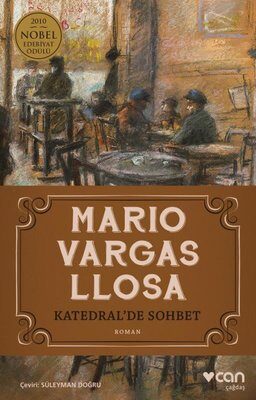
“Bu koşturmaca beni susattı,” diyor Santiago. “Gel hadi bir şey içelim. Buralarda bildiğin bir yer var mı?” “Yemek yediğim bir yer var,” diyor Ambrosio. “İsmi Katedral, garibanların mekânı, bilmem beğenir misiniz?” “Eğer soğuk biraları varsa beğenirim,” diyor Santiago. “Gidelim, Ambrosio.”
1950’ler Lima’sı, General Odría diktatörlüğü dönemi. Farklı sınıflara mensup Zavalita ile Ambrosio yıllar sonra tesadüfen karşılaşıp Katedral adlı barda sohbete dalınca özgürlük ve özgürlüğün yitirilmesi etrafında gelişen bir anlatı ortaya çıkar.
Mario Vargas Llosa’nın, “Hiçbir romanım bana onun kadar emeğe mal olmadı, eğer yazdıklarım arasında yangından sadece bir romanımı kurtarmak zorunda kalsaydım onu kurtarırdım,” diye tanımladığı Katedral’de Sohbet Peru tarihini kişisel yaşanmışlıklarla kesiştiren bir başyapıt.
جزئیات کتاب
نقدها
مشاهده همه
The narrative is set in the fifties, in Peru, during the time of the dictator Manuel A. Odría. The book was published in 1969 and was the third novel by Mario Vargas Llosa. This narrative proposal was likely one of his most ambitious, although this difficulty is not always perceived by the reader, because the context is somewhat disconcerting and difficult to understand, especially if the characters and the history of those places have not been studied or are not known, at least in part.
As the book's title mentions, the story takes place at "La Catedral," a peripheral bar in a district of Lima, Peru. It is centered on the conversation between a bourgeois journalist with ideals of change, known as Zavalita (Santiago Zavala), and his father's former driver, named Ambrosio. The novel shows the malaise and apathy of a people subdued by an authoritarian and arbitrary power, a circumstance caused by the dictatorship of the 1950s. It also shows the presentation of a seemingly democratic government, but which masks an oligarchy focused on those political parties that are in a permanent status quo.
The government is indifferent to the real problems of the sovereign people: a circumstance that leads to the elimination of anti-democratic rights among the representatives. The common interests of a people become non-existent. And the result will be the rise of a new group of people who are corrupt and who are only pursuing their own interests: the individual, as well as his own values, will be abolished to be replaced by a multitude of different and not yet well-defined people. All people who apparently have good intentions, who emphasize phrases related to the rights of citizens and the freedom of the human being.
The structure of the book is complex, built with overlapping, fragmented dialogues. Sometimes the dialogues are even confusing to read: however, according to the writer, the dialogues are part of a rich life inherent to the social mosaic of the place and those times.
The story is always confined to isolation and within a society in crisis. A society that does not recognize itself in its political representatives: from this point of view, the novel turns into a true psychological drama of the losers. People who were already living in utter misery.
In the dialogues of the main characters, a personal and collective failure emerges. There is a disillusionment with ideologies, born in part from what were supposed to be the different signs of a presumed change in their lives: these are all signs that subsequently become demagogic and the positions of a sectarian organization