

جزئیات کتاب
فرمت
جلد نرم
صفحات
352
زبان
انگلیسی
منتشر شده
Feb 24, 2002
ناشر
Princeton University Press
نسخه
1st Paperback Printing
ISBN-10
0691092850
ISBN-13
9780691092850
توضیحات
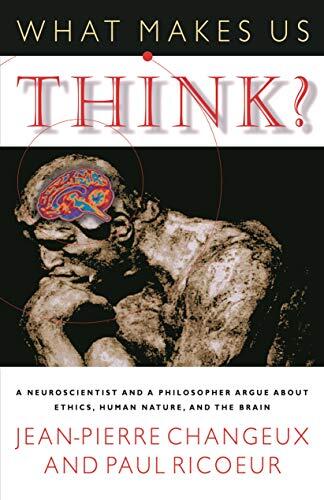
Will understanding our brains help us to know our minds? Or is there an unbridgeable distance between the work of neuroscience and the workings of human consciousness? In a remarkable exchange between neuroscientist Jean-Pierre Changeux and philosopher Paul Ricoeur, this book explores the vexed territory between these divergent approaches--and comes to a deeper, more complex perspective on human nature.Ranging across diverse traditions, from phrenology to PET scans and from Spinoza to Charles Taylor, What Makes Us Think? revolves around a central issue: the relation between the facts (or "what is") of science and the prescriptions (or "what ought to be") of ethics. Changeux and Ricoeur ask: Will neuroscientific knowledge influence our moral conduct? Is a naturally based ethics possible? Pursuing these questions, they attack key topics at the intersection of philosophy and neuroscience: What are the relations between brain states and psychological experience? Between language and truth? Memory and culture? Behavior and action? What is a mental representation? How does a sign relate to what it signifies? How might subjective experience be constructed rather than discovered? And can biological or cultural evolution be considered progressive? Throughout, Changeux and Ricoeur provide unprecedented insight into what neuroscience can--and cannot--tell us about the nature of human experience.Changeux and Ricoeur bring an unusual depth of engagement and breadth of knowledge to each other's subject. In doing so, they make two often hostile disciplines speak to one another in surprising and instructive ways--and speak with all the subtlety and passion of conversation at its verybest. Christian Century - Carol Albright Despite their disparities, the two manage to converse intensely and well. The dialogue benefits from each partner's ability to listen carefully and respond clearly, and also from the long perspective, based in intellectual history, each takes. The focus of the dialogue is neuroscience and its relevance to ethics.
ژانرها
عاشقانه
علم و فناوری
تاریخ
فلسفه
طبیعت
روانشناسی