

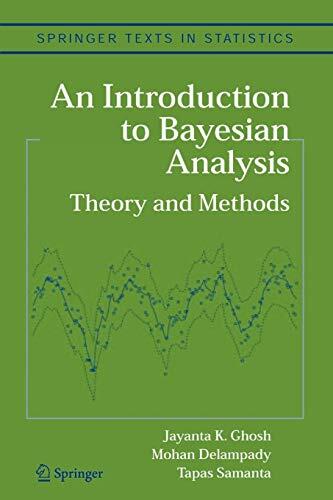
Description
Bayesian analysis is a powerful statistical framework that combines prior knowledge with new evidence to draw inferences. This comprehensive work covers the theoretical underpinnings of Bayesian methods, giving readers insights into the rationale and principles that govern this approach. The authors delve into crucial concepts, ensuring a lucid understanding of probability distributions, Bayes’ theorem, and model comparison, linking them to real-world applications and decision-making processes.
Furthermore, the text invites readers to engage with practical methodologies that extend Bayesian analysis, showcasing various techniques and software tools essential for application. Through illustrative examples and exercises, readers will gain hands-on experience, connecting theory to practice. This book serves not only as a foundational resource for students and researchers but also as a reference for practitioners seeking to leverage Bayesian techniques in their respective fields. The authors' expertise provides a solid platform for anyone looking to navigate the complexities of statistical inference through a Bayesian lens.
Furthermore, the text invites readers to engage with practical methodologies that extend Bayesian analysis, showcasing various techniques and software tools essential for application. Through illustrative examples and exercises, readers will gain hands-on experience, connecting theory to practice. This book serves not only as a foundational resource for students and researchers but also as a reference for practitioners seeking to leverage Bayesian techniques in their respective fields. The authors' expertise provides a solid platform for anyone looking to navigate the complexities of statistical inference through a Bayesian lens.
Détails du livre
Format
Broché
Pages
367 pages
Langue
Anglais
Publié
Nov 19, 2010
Éditeur
Springer
Édition
Softcover reprint of hardcover 1st ed. 2006
Éditions
3 éditions
ISBN-10
1441923039
ISBN-13
9781441923035