

Description
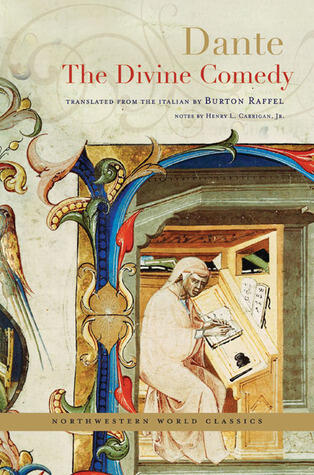
At the midpoint of his life, during Holy Week in 1300, Dante awakes to himself in the middle of a forest so dark that the sun’s light cannot penetrate its gloom. of the wildness and brutality of the woods, Dante cries out for help, and thus begins one of Western literature’s greatest epic journeys.
The Divine Comedy follows Dante the pilgrim—guided by the great Roman poet Virgil, then by the love of his life, Beatrice—as he travels downward through Hell, then upward through Purgatory in order to reach Paradise and witness the love that moves the sun and the stars. Raffel’s translation vividly captures the divine contrapasso , the ultimate case of the punishment the crime, in the Inferno , while fathoming the complexity of the Purgatorio and the ecstasy of the Paradiso .
One of the world’s greatest works of literature, Dante’s Commedia revolutionized poetry and the Italian language. This epic poem was the to be written in the vernacular of the Italian people rather than in Latin. In it, Dante weaves the best of classical literature from Virgil, Statius, Aristotle, and Ovid with staples from the Christian tradition (including the Scriptures, Augustine, and Aquinas), into a colorful medieval tapestry that depicts at once the vividly checkered history of church and empire.
The Divine Comedy follows Dante the pilgrim—guided by the great Roman poet Virgil, then by the love of his life, Beatrice—as he travels downward through Hell, then upward through Purgatory in order to reach Paradise and witness the love that moves the sun and the stars. Raffel’s translation vividly captures the divine contrapasso , the ultimate case of the punishment the crime, in the Inferno , while fathoming the complexity of the Purgatorio and the ecstasy of the Paradiso .
One of the world’s greatest works of literature, Dante’s Commedia revolutionized poetry and the Italian language. This epic poem was the to be written in the vernacular of the Italian people rather than in Latin. In it, Dante weaves the best of classical literature from Virgil, Statius, Aristotle, and Ovid with staples from the Christian tradition (including the Scriptures, Augustine, and Aquinas), into a colorful medieval tapestry that depicts at once the vividly checkered history of church and empire.
Détails du livre
Format
Relié
Pages
888 pages
Langue
Anglais
Publié
Sep 30, 2010
Éditeur
Northwestern University Press
Éditions
1477 éditions
ISBN-10
0810126729
ISBN-13
9780810126725
Genres
Romance
Mystère
Science-fiction
Thriller & Suspense
Biographie
Action & Aventure
Autobiographie & Mémoire
Développement personnel
Religion & Spiritualité
Science & Technologie
Histoire
Horreur
Humour
Affaires & Économie
Philosophie
Fantaisie
Manga
Romans graphiques
Poésie
Livres de cuisine
Voyage
Santé et Bien-être
Art et Photographie
Crime
Classiques
Contemporain
Politique
Nature
Psychologie