

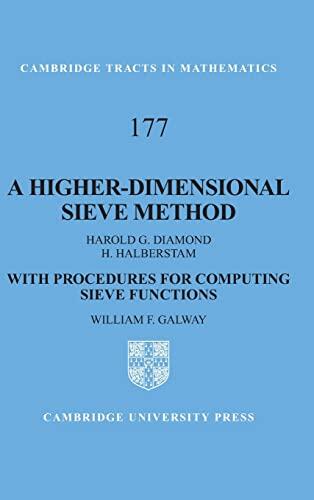
Dettagli del libro
Formato
Copertina rigida
Pagine
290
Lingua
Inglese
Pubblicato
Nov 3, 2008
Editore
Cambridge University Press
ISBN-10
0521894875
ISBN-13
9780521894876
Descrizione
In the realm of number theory, the exploration of sieve methods holds profound significance, and this work presents a contemporary examination of those concepts. Delving into the evolution of these mathematical tools, the authors guide readers through nearly a century of advancements that have been influenced by Viggo Brun's pioneering techniques. Their insightful analysis reveals the enduring relevance of sieving as a powerful strategy for addressing complex problems in prime number distribution.
Focusing on higher-dimensional sieves, the authors introduce innovative procedures for computing sieve functions, making the intricate subject more accessible to mathematicians and students alike. With a blend of theoretical exploration and practical applications, they provide clear explanations that shine a light on the nuances of the sieve process. The book serves not only as an academic resource but also as a catalyst for deeper inquiry into the mathematics of primes.
Through rigorous examples and a comprehensive approach, this work stands as a significant contribution to the field, encouraging further exploration and understanding of high-dimensional sieving techniques. Readers will find both a rich historical context and a modern perspective that equips them with the tools to tackle ongoing challenges in number theory.
Focusing on higher-dimensional sieves, the authors introduce innovative procedures for computing sieve functions, making the intricate subject more accessible to mathematicians and students alike. With a blend of theoretical exploration and practical applications, they provide clear explanations that shine a light on the nuances of the sieve process. The book serves not only as an academic resource but also as a catalyst for deeper inquiry into the mathematics of primes.
Through rigorous examples and a comprehensive approach, this work stands as a significant contribution to the field, encouraging further exploration and understanding of high-dimensional sieving techniques. Readers will find both a rich historical context and a modern perspective that equips them with the tools to tackle ongoing challenges in number theory.