

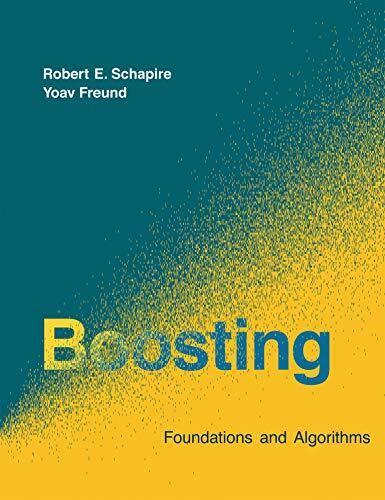
Descrizione
This work delves into the foundational theories and algorithms behind boosting, a powerful machine learning technique. Authored by two prominent figures in the field, it meticulously outlines the underlying principles that make boosting a staple in both academic and practical applications. The authors provide a deep exploration of how boosting improves the accuracy of models by converting weak learners into a robust ensemble, capable of making nuanced predictions.
The content is structured to cater to both newcomers and seasoned practitioners. It explains the complexities of boosting algorithms in an accessible manner while also providing rigorous proofs and theoretical insights. Schapire and Freund emphasize the importance of understanding the algorithmic foundations, showcasing how boosting has evolved and where it is currently employed in various sectors.
Readers can expect to gain a solid grasp of various boosting techniques, alongside practical assessments of their performance. The clarity of exposition combined with a rich array of examples makes it an indispensable resource for anyone aspiring to harness the potential of boosting in their machine learning endeavors.
Overall, this book serves as a comprehensive guide that effectively bridges theoretical knowledge with practical application, establishing itself as a critical resource in the fields of adaptive computation and machine learning.
The content is structured to cater to both newcomers and seasoned practitioners. It explains the complexities of boosting algorithms in an accessible manner while also providing rigorous proofs and theoretical insights. Schapire and Freund emphasize the importance of understanding the algorithmic foundations, showcasing how boosting has evolved and where it is currently employed in various sectors.
Readers can expect to gain a solid grasp of various boosting techniques, alongside practical assessments of their performance. The clarity of exposition combined with a rich array of examples makes it an indispensable resource for anyone aspiring to harness the potential of boosting in their machine learning endeavors.
Overall, this book serves as a comprehensive guide that effectively bridges theoretical knowledge with practical application, establishing itself as a critical resource in the fields of adaptive computation and machine learning.
Dettagli del libro
Formato
Brossura
Pagine
543 pagine
Lingua
Inglese
Pubblicato
Jan 10, 2014
Editore
MIT Press
Edizione
Illustrated
Edizioni
3 editions
ISBN-10
0262526034
ISBN-13
9780262526036