Descrizione
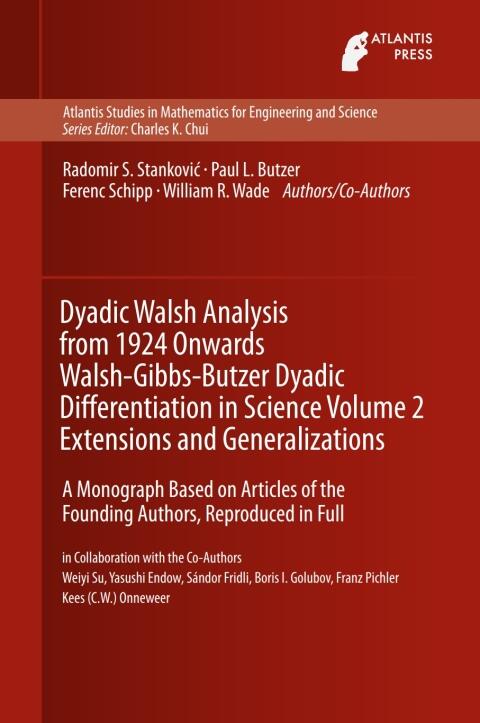
Radomir Stankovic and his team present an influential exploration into dyadic Walsh analysis, expanding the foundational concepts originally established in 1924. This second volume delves deeper into the numerous extensions and generalizations that have emerged in the field, inviting readers to engage with complex theories that bridge both engineering and scientific disciplines. The authors, a diverse group of experts, each contribute their unique insights and research findings, showcasing the collaborative nature of contemporary scientific inquiry.
The monograph takes a methodical approach, providing a robust mathematical framework that enhances understanding of dyadic differentiation. Readers will find thorough discussions about the implications of these extensions on real-world applications, illustrating how abstract concepts can lead to tangible advancements in technology and engineering practices. The depth of analysis reflects the authors' commitment to both clarity and rigor, making advanced topics accessible to a wide audience.
Each chapter of this volume is laden with scholarly detail, featuring discussions that push the boundaries of current knowledge. With a focus on interdisciplinary connections, the authors emphasize the relevance of dyadic Walsh analysis across various scientific fields, including signal processing, data compression, and systems theory. Their collective effort not only contributes to academic literature but also serves as a valuable resource for researchers and practitioners seeking to innovate within their domains.
Ultimately, this comprehensive work is a testament to the ongoing evolution of dyadic methods, urging readers to appreciate the rich tapestry of ideas and applications that have developed over nearly a century. The collaborative spirit among the authors enhances the narrative, making this volume an essential addition to any academic library and a vital tool for professionals striving to stay at the forefront of engineering and science.
Dettagli del libro
Formato
Kindle
Pagine
378 pagine
Lingua
Olandese, Fiammingo
Pubblicato
gen 1, 2015
Editore
Atlantis Press
Edizione
1st ed. 2015
ISBN-10
9462391637
ISBN-13
9789462391635