

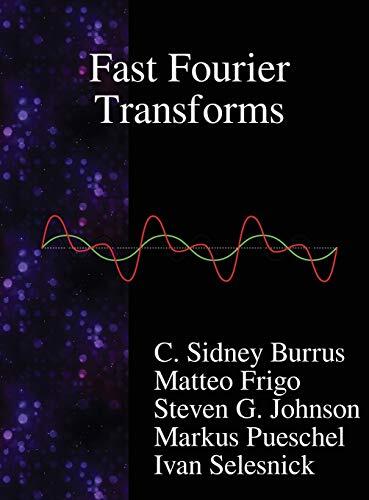
Dettagli del libro
Formato
Copertina rigida
Pagine
252
Lingua
Inglese
Pubblicato
Jan 7, 2018
Editore
Samurai Media Limited
ISBN-10
988840752X
ISBN-13
9789888407521
Descrizione
Exploring the intricate world of signal processing, this work delves into the Fast Fourier Transform (FFT), a foundational algorithm for efficiently computing discrete Fourier transforms. It offers an in-depth examination of both the theoretical underpinnings and practical applications of FFT, making it a vital resource for students, engineers, and researchers alike.
Readers will appreciate the authors' clarity in explaining complex concepts. Through a blend of mathematical rigor and intuitive insights, they demystify the algorithm, showcasing its relevance in various fields including telecommunications, data analysis, and audio processing. The book also addresses optimization techniques and provides numerous examples that illustrate how FFT can be implemented effectively in real-world scenarios.
A thorough treatment of both fundamental principles and advanced topics ensures that readers gain a comprehensive understanding. Each chapter builds upon the last, guiding them through both the challenges and breakthroughs that have shaped the evolution of FFT.
Ultimately, this work stands as a testament to the significance of Fast Fourier Transforms in modern computing, equipping readers with the knowledge necessary to harness its power in their own projects and research endeavors.
Readers will appreciate the authors' clarity in explaining complex concepts. Through a blend of mathematical rigor and intuitive insights, they demystify the algorithm, showcasing its relevance in various fields including telecommunications, data analysis, and audio processing. The book also addresses optimization techniques and provides numerous examples that illustrate how FFT can be implemented effectively in real-world scenarios.
A thorough treatment of both fundamental principles and advanced topics ensures that readers gain a comprehensive understanding. Each chapter builds upon the last, guiding them through both the challenges and breakthroughs that have shaped the evolution of FFT.
Ultimately, this work stands as a testament to the significance of Fast Fourier Transforms in modern computing, equipping readers with the knowledge necessary to harness its power in their own projects and research endeavors.