

Dettagli del libro
Formato
Brossura
Pagine
216
Lingua
Inglese
Pubblicato
Jul 8, 2015
Editore
CreateSpace Independent Publishing Platform
ISBN-10
1514895439
ISBN-13
9781514895436
Descrizione
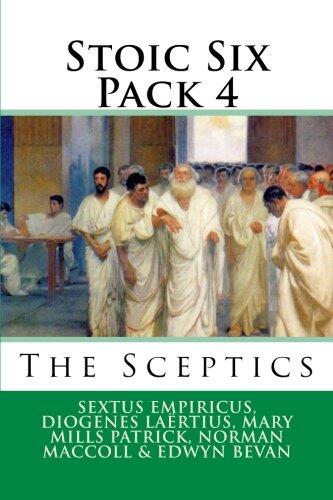
"The truth is hypothetical." Scepticism (or skepticism), the belief that requires all information to be well supported by evidence, originated in the Skeptikoi, a first century BC Greek school who "asserted nothing." The school was founded by Aenesidemus; our main source of the school's teachings is Sextus Empiricus and the leader of the Sceptics was Pyrrho of Elis (365-275 BC) who had traveled to India and studied with the gymnosophists ('naked lovers of wisdom'). From India, Pyrrho brought back the idea that nothing can be known for certain. The senses are easily fooled, and reason follows too easily our desires. Along with Stoicism and Epicureanism, Scepticism was one of the three dominant schools of Hellenistic Philosophy.
A sextet of sceptic texts has been collected in this anthology:
Pyrrhonic Sketches by Sextus Empiricus.
Life of Pyrrho by Diogenes La�rtius.
Sextus Empiricus and Greek Scepticism by Mary Mills Patrick.
The Greek Sceptics: from Pyrrho to Sextus by Norman MacColl.
Stoics and Sceptics by Edwyn Bevan.
Life of Carneades by Diogenes La�rtius.
A key concept for the sceptics was ataraxia ("tranquility"), a Greek term used by Pyrrho to describe a lucid state of robust tranquility, characterized by ongoing freedom from distress and worry. By applying ideas of what he called "practical skepticism" to Ethics and to life in general, Pyrrho concluded that ataraxia could be achieved. Arriving at a state of ataraxia became the ultimate goal of the early Skeptikoi.
"Skepticism is the first step toward truth."
- Denis Diderot
A sextet of sceptic texts has been collected in this anthology:
Pyrrhonic Sketches by Sextus Empiricus.
Life of Pyrrho by Diogenes La�rtius.
Sextus Empiricus and Greek Scepticism by Mary Mills Patrick.
The Greek Sceptics: from Pyrrho to Sextus by Norman MacColl.
Stoics and Sceptics by Edwyn Bevan.
Life of Carneades by Diogenes La�rtius.
A key concept for the sceptics was ataraxia ("tranquility"), a Greek term used by Pyrrho to describe a lucid state of robust tranquility, characterized by ongoing freedom from distress and worry. By applying ideas of what he called "practical skepticism" to Ethics and to life in general, Pyrrho concluded that ataraxia could be achieved. Arriving at a state of ataraxia became the ultimate goal of the early Skeptikoi.
"Skepticism is the first step toward truth."
- Denis Diderot