

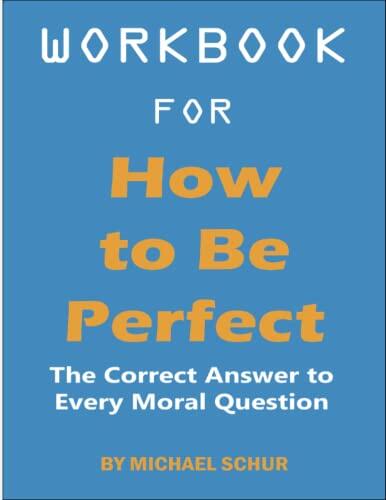
Dettagli del libro
Formato
Brossura
Pagine
53
Lingua
Inglese
Pubblicato
Feb 1, 2022
Editore
Independently published
ISBN-13
9798410972871
Descrizione
Note: This Workbook is meant to be a Companion to the Original Book by Michael Schur. Designed to Enrich Your Reading Experience. Its all you need to understand the main book better.
Most people think of themselves as “good,” but it’s not always easy to determine what’s “good” or “bad”—especially in a world filled with complicated choices and pitfalls and booby traps and bad advice. Fortunately, many smart philosophers have been pondering this conundrum for millennia and they have guidance for us. With bright wit and deep insight, How to Be Perfect explains concepts like deontology, utilitarianism, existentialism, ubuntu, and more so we can sound cool at parties and become better people.
Schur starts off with easy ethical questions like “Should I punch my friend in the face for no reason?” (No.) and works his way up to the most complex moral issues we all face. Such Can I still enjoy great art if it was created by terrible people? How much money should I give to charity? Why bother being good at all when there are no consequences for being bad? And much more. By the time the book is done, we’ll know exactly how to act in every conceivable situation, so as to produce a verifiably maximal amount of moral good. We will be perfect, and all our friends will be jealous. OK, not quite. Instead, we’ll gain fresh, funny, inspiring wisdom on the toughest issues we face every day.
Most people think of themselves as “good,” but it’s not always easy to determine what’s “good” or “bad”—especially in a world filled with complicated choices and pitfalls and booby traps and bad advice. Fortunately, many smart philosophers have been pondering this conundrum for millennia and they have guidance for us. With bright wit and deep insight, How to Be Perfect explains concepts like deontology, utilitarianism, existentialism, ubuntu, and more so we can sound cool at parties and become better people.
Schur starts off with easy ethical questions like “Should I punch my friend in the face for no reason?” (No.) and works his way up to the most complex moral issues we all face. Such Can I still enjoy great art if it was created by terrible people? How much money should I give to charity? Why bother being good at all when there are no consequences for being bad? And much more. By the time the book is done, we’ll know exactly how to act in every conceivable situation, so as to produce a verifiably maximal amount of moral good. We will be perfect, and all our friends will be jealous. OK, not quite. Instead, we’ll gain fresh, funny, inspiring wisdom on the toughest issues we face every day.
Generi
Umorismo
Business ed Economia
Arte e Fotografia