

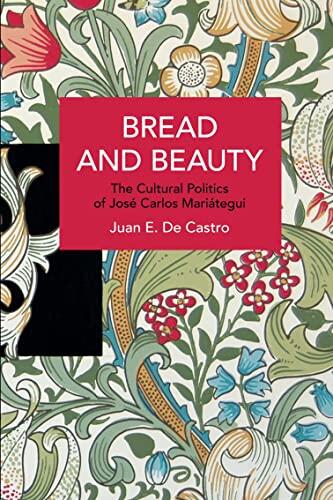
Bread and Beauty: The Cultural Politics of José Carlos Mariátegui
によって
Juan E. De Castro
まだ評価がありません
形式
ペーパーバック
ページ数
256
言語
英語
公開されました
Oct 22, 2021
出版社
Haymarket Books
ISBN-10
1642595977
ISBN-13
9781642595970
説明
Through a detailed examination of José Carlos Mariátegui's contributions to both cultural and political landscapes, this work delves deeply into the intersections of Marxist theory and Peruvian identity. Juan E. De Castro skillfully navigates Mariátegui’s complex ideologies, highlighting how he envisioned culture as a central aspect of revolutionary thought, rather than a mere byproduct of economic conditions.
The narrative explores Mariátegui's assertion that a true understanding of society must encompass its cultural dimensions, challenging the traditional binaries often seen in Marxist discourse. De Castro brings to light Mariátegui's unique perspective on how the cultural struggle can coexist and intertwine with political activism, particularly within the context of Peru's indigenous and working-class populations.
This exploration also situates Mariátegui within a broader historical framework, connecting his work to global movements and the struggles faced by marginalized communities. Through rich analysis and insightful interpretations, De Castro celebrates Mariátegui's legacy while examining the implications of his thought for contemporary social movements.
Ultimately, the study serves not only as a tribute to Mariátegui’s influence but also as an invitation to reconsider the potential of culture in shaping political and social realities. It is a compelling read for those seeking to understand the transformative power of art, literature, and culture in the ongoing quest for justice and equality.
The narrative explores Mariátegui's assertion that a true understanding of society must encompass its cultural dimensions, challenging the traditional binaries often seen in Marxist discourse. De Castro brings to light Mariátegui's unique perspective on how the cultural struggle can coexist and intertwine with political activism, particularly within the context of Peru's indigenous and working-class populations.
This exploration also situates Mariátegui within a broader historical framework, connecting his work to global movements and the struggles faced by marginalized communities. Through rich analysis and insightful interpretations, De Castro celebrates Mariátegui's legacy while examining the implications of his thought for contemporary social movements.
Ultimately, the study serves not only as a tribute to Mariátegui’s influence but also as an invitation to reconsider the potential of culture in shaping political and social realities. It is a compelling read for those seeking to understand the transformative power of art, literature, and culture in the ongoing quest for justice and equality.