

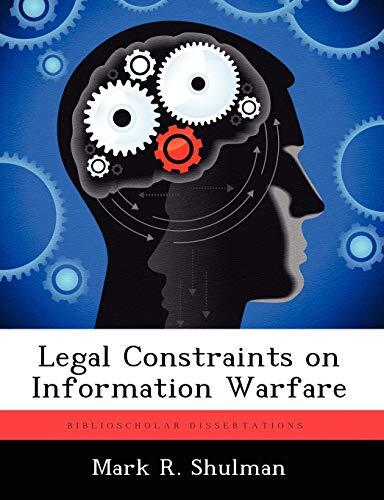
Legal Constraints on Information Warfare
によって
Mark R. Shulman
まだ評価がありません
Romance
Science & Technology
形式
ペーパーバック
ページ数
38
言語
英語
公開されました
Oct 17, 2012
出版社
Biblioscholar
版
Illustrated
ISBN-10
1249834872
ISBN-13
9781249834878
説明
Mark R. Shulman's exploration delves into the intricate intersection of law and the rapidly evolving realm of information warfare. In a world where digital landscapes are as battlegrounds, the legal frameworks surrounding these conflicts are progressively crucial. Shulman meticulously analyzes how traditional legal principles are applied and adapted in the context of cyber operations and information manipulation.
The narrative unfolds with a detailed examination of various legal domains, from international law to national regulations, revealing the challenges that arise in enforcing these laws amidst the fluidity of technology. Shulman raises critical questions about accountability and jurisdiction, highlighting the complexities faced by governments and organizations when navigating this uncharted territory.
Through case studies and real-world examples, the author illustrates the potential consequences of ignoring these legal constraints in both offensive and defensive strategies. The work aims to provide policymakers, military strategists, and scholars with insights into establishing a more coherent legal approach to information warfare.
Shulman's erudition and clarity make this analysis not only informative but also an essential resource for understanding the pressing legal issues in the modern age of warfare. He asserts that as technology continues to advance, so too must our legal frameworks evolve to address the unique challenges posed by the digital domain.
The narrative unfolds with a detailed examination of various legal domains, from international law to national regulations, revealing the challenges that arise in enforcing these laws amidst the fluidity of technology. Shulman raises critical questions about accountability and jurisdiction, highlighting the complexities faced by governments and organizations when navigating this uncharted territory.
Through case studies and real-world examples, the author illustrates the potential consequences of ignoring these legal constraints in both offensive and defensive strategies. The work aims to provide policymakers, military strategists, and scholars with insights into establishing a more coherent legal approach to information warfare.
Shulman's erudition and clarity make this analysis not only informative but also an essential resource for understanding the pressing legal issues in the modern age of warfare. He asserts that as technology continues to advance, so too must our legal frameworks evolve to address the unique challenges posed by the digital domain.