

책 세부 정보
형식
페이퍼백
페이지
428
언어
영어
출판됨
Aug 12, 2008
출판사
Springer
ISBN-10
0817670815
ISBN-13
9780817670818
설명
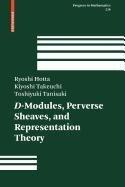
This work delves into the intricate interplay between D-modules, perverse sheaves, and representation theory, drawing on advanced concepts in operator theory. The authors, Ryoshi Hotta, Kiyoshi Takeuchi, and Toshiyuki Tanisaki, combine their expertise to offer readers a comprehensive understanding of these mathematical constructs. The book meticulously explores the applications of D-modules in various mathematical contexts, highlighting their significance in the realm of representation theory.
Through detailed explanations and examples, the authors guide readers on a journey through the theoretical foundations of perverse sheaves. This concept, which serves as a bridge between topology and algebra, is presented in a manner that is both rigorous and accessible, making it suitable for both seasoned mathematicians and those new to the field. The book underscores how these advanced mathematical tools can be applied to solve complex problems, illustrating their relevance in contemporary mathematical research.
Rich with insights and fostering a deep appreciation for the subject, this volume serves as an essential resource for those looking to expand their knowledge in operator theory and its multifaceted applications. The authors' collaborative effort results in a well-structured and insightful text that promises to illuminate the connections between diverse areas of mathematics.
Through detailed explanations and examples, the authors guide readers on a journey through the theoretical foundations of perverse sheaves. This concept, which serves as a bridge between topology and algebra, is presented in a manner that is both rigorous and accessible, making it suitable for both seasoned mathematicians and those new to the field. The book underscores how these advanced mathematical tools can be applied to solve complex problems, illustrating their relevance in contemporary mathematical research.
Rich with insights and fostering a deep appreciation for the subject, this volume serves as an essential resource for those looking to expand their knowledge in operator theory and its multifaceted applications. The authors' collaborative effort results in a well-structured and insightful text that promises to illuminate the connections between diverse areas of mathematics.