

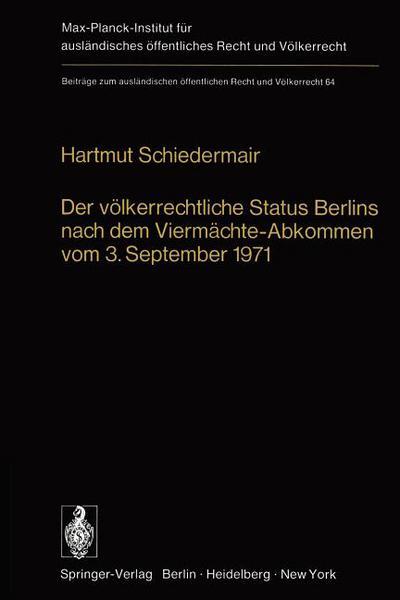
Der völkerrechtliche Status Berlins nach dem Viermächte-Abkommen vom 3. September 1971
작성자
H. Schiedermair
아직 평점이 없습니다
형식
페이퍼백
페이지
234
언어
독일어
출판됨
Apr 14, 2012
출판사
Springer
판
Softcover reprint of the original 1st ed. 1975
ISBN-10
3642454542
ISBN-13
9783642454547
설명
H. Schiedermair delves into the intricate legal framework surrounding Berlin's status following the Four-Power Agreement of September 3, 1971. This work provides a comprehensive examination of the political and legal implications of the agreement that shaped Berlin during the tumultuous Cold War era. Through meticulous analysis, Schiedermair illuminates how international law and diplomatic relations influenced the governance and division of this iconic city, reflecting broader geopolitical tensions.
The author navigates the historical context and nuances of the Four-Power Agreement, addressing its impact on East and West Berlin. Schiedermair's scholarly exploration emphasizes the nuanced relationship between international law and national sovereignty, revealing the complexities that arose from the divided status of Berlin. This work serves as an essential reference for those interested in international law, diplomatic history, and the unique status of cities in geopolitical conflicts.
Schiedermair’s research is not only informative but also contextualizes Berlin's legal status within the broader narrative of post-war Europe. The book stands as a significant contribution to the field, appealing to legal scholars, historians, and policymakers alike, as it uncovers the delicate balance of power that defined a city caught between competing ideologies.
The author navigates the historical context and nuances of the Four-Power Agreement, addressing its impact on East and West Berlin. Schiedermair's scholarly exploration emphasizes the nuanced relationship between international law and national sovereignty, revealing the complexities that arose from the divided status of Berlin. This work serves as an essential reference for those interested in international law, diplomatic history, and the unique status of cities in geopolitical conflicts.
Schiedermair’s research is not only informative but also contextualizes Berlin's legal status within the broader narrative of post-war Europe. The book stands as a significant contribution to the field, appealing to legal scholars, historians, and policymakers alike, as it uncovers the delicate balance of power that defined a city caught between competing ideologies.