

책 세부 정보
형식
하드커버
페이지
268
언어
영어
출판됨
Dec 15, 2022
출판사
Lexington Books
ISBN-10
1793613109
ISBN-13
9781793613103
설명
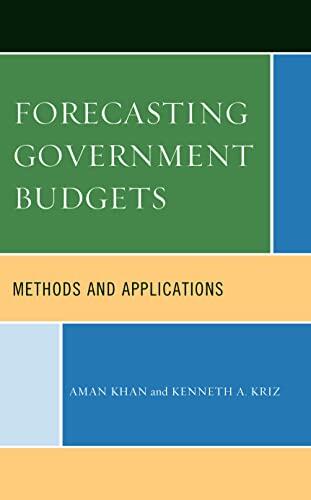
In the realm of public finance, accurately forecasting government budgets is an essential skill that can have significant impacts on economic stability and growth. A comprehensive exploration by Aman Khan and Kenneth A. Kriz delves into various methodologies for predicting budgetary outcomes. Their work provides a thorough examination of both quantitative techniques and qualitative approaches, making it accessible to a wide range of readers, from policymakers to academic researchers.
By breaking down complex concepts into digestible segments, the authors present a detailed overview of the challenges governments face in budget forecasting. They highlight the importance of integrating data analysis with real-world applications, showcasing case studies and practical examples that illustrate successful forecasting outcomes. This creates a bridge between theory and practice, enhancing the reader's understanding of how to apply these methods effectively in different governmental contexts.
Khan and Kriz also emphasize the role of uncertainty in budget forecasting, discussing how external factors such as economic shifts, political changes, and social dynamics can influence financial predictions. Their insights into risk management techniques further enrich the discourse, encouraging readers to consider adaptable strategies in their forecasting endeavors.
Ultimately, this work serves as both a guide and a resource, arming stakeholders with the knowledge to make informed financial decisions that can navigate the complexities of governmental budgets. Through their analytical lens, Khan and Kriz invite readers to engage with the intricacies of public finance, fostering a deeper appreciation for the art and science of budget forecasting.
By breaking down complex concepts into digestible segments, the authors present a detailed overview of the challenges governments face in budget forecasting. They highlight the importance of integrating data analysis with real-world applications, showcasing case studies and practical examples that illustrate successful forecasting outcomes. This creates a bridge between theory and practice, enhancing the reader's understanding of how to apply these methods effectively in different governmental contexts.
Khan and Kriz also emphasize the role of uncertainty in budget forecasting, discussing how external factors such as economic shifts, political changes, and social dynamics can influence financial predictions. Their insights into risk management techniques further enrich the discourse, encouraging readers to consider adaptable strategies in their forecasting endeavors.
Ultimately, this work serves as both a guide and a resource, arming stakeholders with the knowledge to make informed financial decisions that can navigate the complexities of governmental budgets. Through their analytical lens, Khan and Kriz invite readers to engage with the intricacies of public finance, fostering a deeper appreciation for the art and science of budget forecasting.