

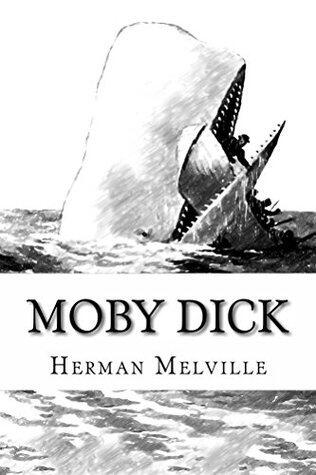
설명
The product of a year and a half of writing, the book draws on Melville's own whaling experience, on his reading in whaling literature, and on literary inspirations such as Shakespeare and the Bible. The detailed and realistic descriptions of whale hunting and the process of extracting whale oil, as well as life aboard ship among a culturally diverse crew, are mixed with exploration of class and social status, good and evil, and the existence of God. In addition to narrative prose, Melville uses a wide range of styles and literary devices ranging from songs, poetry and catalogs to Shakespearean stage directions, soliloquies, and asides.
The author changed the title at the very last moment in September 1851, and so the work first appeared as The Whale in London in October 1851, and then under its definitive title Moby-Dick in New York in November. The British edition of five hundred copies was not reprinted during the author's life, the American of almost three thousand was reprinted three times at approximately 250 copies, the last reprinting in 1871. These figures are exaggerated because three hundred copies were destroyed in a fire at Harper's; only 3,200 copies were actually sold during the author's life.
A commercial failure and out of print at the time of the author's death in 1891, its reputation grew immensely during the twentieth century. According to D.H. Lawrence, it is "one of the strangest and most wonderful books in the world," and "the greatest book of the sea ever written."
Dedicated to Nathaniel Hawthorne, "in token of my admiration for his genius," Moby-Dick is considered a Great American Novel and an outstanding work of the Romantic Period in America, a period also known as the American Renaissance. "Call me Ishmael," is one of world literature's most famous opening sentences.
책 세부 정보
장르들
리뷰
모두 보기
Group project goes wrong because the leader is way too into whales.funnily enough, that's happened to me in real life

I really hate it when I can't connect with some of the greatest works of art. Moby Dick is sadly one of these!I really tried to enjoy it, but couldn't! It's one of the very few classics which bore me to death. In my opinion, there's very little development when it comes to the characters and the story-line itself. I expected a lot from the author, especially that the book is thick. I told myself here's a story that's going to keep me entertained for a while, but instead I only found an annoyingly massive amount of fishery technicalities. A flat bulk of information to fill the chapters so that the real story can be rewritten in no more than a quarter of the actual number of pages. What bugs me up about this is the uselessness of such details in connection with the direction in which the story moves. The reader could perfectly do without most of that massive amount of waling fishery details! Besides, the characters are mostly flat. There's neither will nor power of will directing their steps and guiding their actions. Take the narrator as an instance. He's a passive observer of everything; merely a man relating his inexistence in the tale. Ahab is another in spite of all his depicted mightiness which remains but empty words. What is he if not simply a stubborn, half-mad, old captain directing a set of dummies who are so flat and two dimensional that I can't even attempt to put them to scrutiny. One thing I know for sure, I am never going to read that book again as I am already giving it away to any student in need of a free copy! And apart from the occasional beauty of its prose and the images which come to the forth every now and then, I regret spending so much time reading it.

Call me Ishmael. Thus starts the greatest American novel. Melville said himself that he wanted to write a mighty book about a mighty theme and so he did. It is a story of one man's obsessive revenge-journey against the white whale, Moby-Dick, who injured him in an earlier meeting.