

책 세부 정보
형식
페이퍼백
페이지
270
언어
러시아어
출판됨
Jan 1, 2009
출판사
Лори
설명
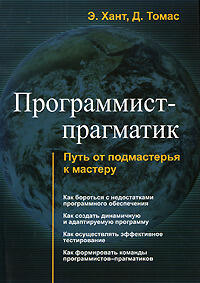
Programmers are craftspeople trained to use a certain set of tools (editors, object managers, version trackers) to generate a certain kind of product (programs) that will operate in some environment (operating systems on hardware assemblies). Like any other craft, computer programming has spawned a body of wisdom, most of which isn't taught at universities or in certification classes. Most programmers arrive at the so-called tricks of the trade over time, through independent experimentation. In The Pragmatic Programmer, Andrew Hunt and David Thomas codify many of the truths they've discovered during their respective careers as designers of software and writers of code.
Some of the authors' nuggets of pragmatism are concrete, and the path to their implementation is clear. They advise readers to learn one text editor, for example, and use it for everything. They also recommend the use of version-tracking software for even the smallest projects, and promote the merits of learning regular expression syntax and a text-manipulation language. Other (perhaps more valuable) advice is more light-hearted. In the debugging section, it is noted that, "if you see hoof prints think horses, not zebras." That is, suspect everything, but start looking for problems in the most obvious places. There are recommendations for making estimates of time and expense, and for integrating testing into the development process. You'll want a copy of The Pragmatic Programmer for two it displays your own accumulated wisdom more cleanly than you ever bothered to state it, and it introduces you to methods of work that you may not yet have considered. Working programmers will enjoy this book. --David Wall
Topics covered: A useful approach to software design and construction that allows for efficient, profitable development of high-quality products. Elements of the approach include specification development, customer relations, team management, design practices, development tools, and testing procedures. This approach is presented with the help of anecdotes and technical problems.
Some of the authors' nuggets of pragmatism are concrete, and the path to their implementation is clear. They advise readers to learn one text editor, for example, and use it for everything. They also recommend the use of version-tracking software for even the smallest projects, and promote the merits of learning regular expression syntax and a text-manipulation language. Other (perhaps more valuable) advice is more light-hearted. In the debugging section, it is noted that, "if you see hoof prints think horses, not zebras." That is, suspect everything, but start looking for problems in the most obvious places. There are recommendations for making estimates of time and expense, and for integrating testing into the development process. You'll want a copy of The Pragmatic Programmer for two it displays your own accumulated wisdom more cleanly than you ever bothered to state it, and it introduces you to methods of work that you may not yet have considered. Working programmers will enjoy this book. --David Wall
Topics covered: A useful approach to software design and construction that allows for efficient, profitable development of high-quality products. Elements of the approach include specification development, customer relations, team management, design practices, development tools, and testing procedures. This approach is presented with the help of anecdotes and technical problems.