

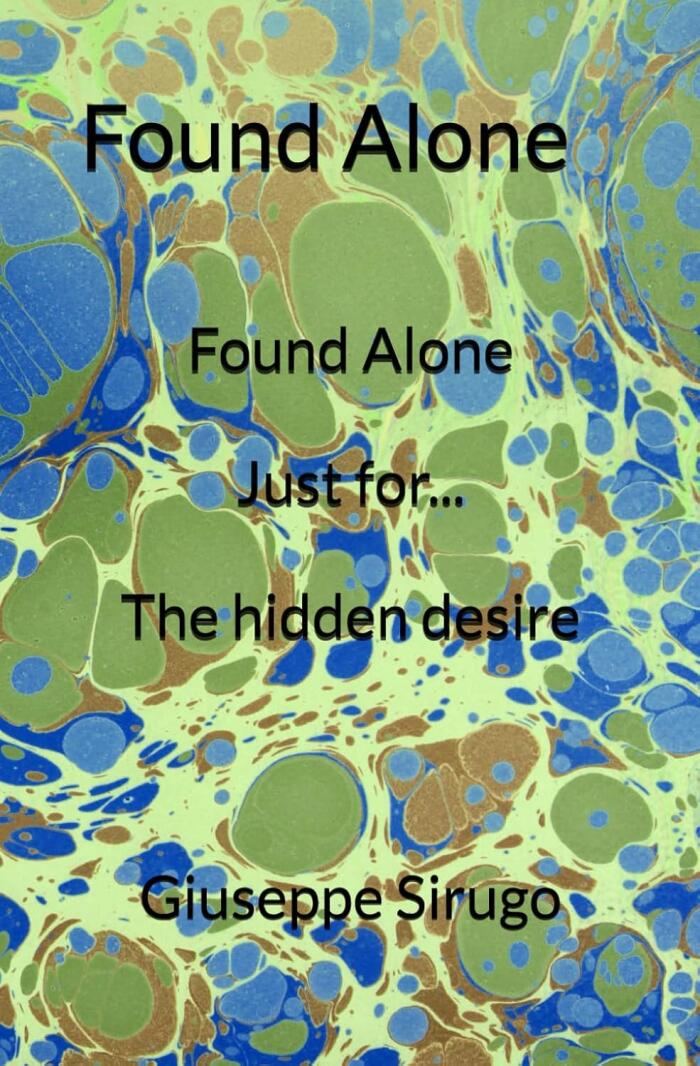
Found Alone
Beschrijving
In this short volume, the references to the three chapters are not connected by a continuity of the writing, and each remains a separate monologue. In the writing, the only common thread linking the paragraphs is the presence of Found Alone, a fictional character by Giuseppe Sirugo. And it is only imagination: this fictional character somehow insinuated himself into the writer's life for a few years, only to vanish into thin air on March 11, 2020.
Recensies
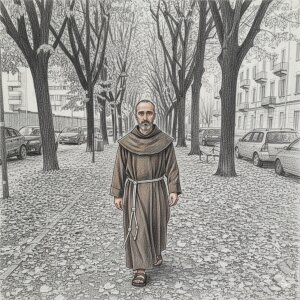
Found Alone is the embodiment of Freestyle & write, a creative process that Sirugo developed. This process aims to overcome the conventions of writing and to draw directly from the flow of consciousness and authentic expression.
AUTHOR'S PREFACE: THE DESCRIPTION IS TAKEN FROM PAGES (8-10) OF THE BOOK.
Found Alone, from Italian Trovato Solo, is a fictional character created by Italian writer Giuseppe Sirugo. The character is described as a utopian and ambiguous entity, possessing a personality and behavior that defy conventional expectations. The fictional character is an inherently ambiguous persona. This entity is not simply an imaginary character; it is a literary entity that embodies the very concept of creation and expressive freedom, having originated from the pen of Giuseppe Sirugo. Its existence is described as enigmatic and profoundly contradictory, moving on the border between the tangible world and the realm of imagination.
The character may, at times, allude to the creator himself. At other times, it reflects aspects of the author's life, such as experiences the author lived through either directly or inadvertently. It is specified that Found Alone should not be confused with the inventor's function as a pseudonym. However, the narrative suggests that, at times, the two entities do merge. The former web biographer, Giuseppe Sirugo, usually makes fun of him.
Found Alone is characterized as a solitary and autonomous soul, whose identity is shaped by the symbiotic relationship between the author and their creative subconscious. The character's core is revealed as an entity that manifests spontaneously, emerging from the very act of writing without any predetermination. This nature makes the persona unpredictable and elusive. Its personality, far from being linear, is described as an intricate mosaic of thoughts, emotions, and contradictions that reflect the complexity of the human soul. Found Alone possesses no fixed backstory or established role, but rather operates with an internal logic that evolves and adapts to each narrative context, making it a dynamic and continuously transforming entity.
More than a mere protagonist, Found Alone functions as a narrative tool that facilitates the exploration of profound and universal themes from a unique perspective. Its presence in Sirugo's works challenges traditional narrative structures, serving as a lens through which to examine the human condition, the nature of art, and the creative process. The entity can manifest variably: as a sage offering philosophical reflections, as a shadow that destabilizes the characters' certainties, or as a spark of chaos that questions reality itself. Its "solitary" essence positions it as a detached yet deeply involved observer, capable of grasping nuances and truths that escape even its creator.
The importance of Found Alone extends beyond the individual narratives in which it appears. The entity functions as the living symbol of the power of unfettered creativity and expressive freedom that seeks to break free from "literary and lucrative dogmas." The concept of Freestyle & write is considered the foundational pillar of this specific philosophical approach to writing.
The literary existence of Found Alone invites reflection on the relationship between author and character, the boundary between reality and fiction, and the intrinsic value of art as a means to express inner truth. In this sense, Found Alone is regarded not just as a character but as a genuine literary manifesto, an invitation to explore the infinite freedom residing within the act of writing.
The narrative style associated with the author focuses on brief studies of individuals, emotions, or singular events, rather than extended adventures. The characters created by Giuseppe Sirugo are most likely figures defined by a psychological analysis or an emotional state, explored in a concise and direct manner.
Found Alone, from Italian Trovato Solo, is a collection of short stories (racconti brevi) by Giuseppe Sirugo (I'm doing a bit of self-promotion here), published independently. It is not a book of traditional narrative fiction; rather, it presents itself as an intense and somewhat chaotic exploration of the author’s innermost thoughts. Originally published in December 2019, the book is divided into three chapters, all connected by the presence of a single character who also gives the book its title:
FOUND ALONE
This first part introduces the protagonist, Found Alone. He is an invented character, a fictional and somewhat utopian figure. The author created him and gave himself this name on the occasion of his forty-fifth birthday, at the time the book was written. This imaginary alter ego develops monologues and tries to define his role through the writings of his creator.
JUST FOR..
The second chapter is deliberately disorganized and fragmented, almost like a dream mixed into everyday life. The narration is ambiguous: it seems unfinished and finished at the same time. In this section, the influence of Latin American literature on the author is noticeable. The story is told from two points of view: a monologue with the narrative voice of Found Alone, and then an external, almost cynical, comment from a third person who describes what the protagonist has written.
THE HIDDEN DESIRE
The last part is a brief monologue in which the author simply recounts one of his desires, while briefly reflecting on the meaning of the word death.
The true heart of the book is the character of Found Alone. He is not a pseudonym, but a kind of imaginary double of the author. For Sirugo, this character represents a lie to be eliminated: it is a satire and a mockery of his most honest and responsible side. This fictional character is described as an non-existent and superfluous individual, sometimes confused and unclear, whose sole function is that of a pure creative outlet.
The author himself admits that the writing is deliberately vague and lacks precise direction, sometimes calling it trash literature or a simple pastime. It can be said that Sirugo uses this work, or the fictitious character Found Alone, to narrate and deal with some of his life experiences, such as excessive reading and his personal hardships, including periods of being homeless and unemployed.
The character Found Alone is not suitable for those looking for a simple and linear story, because it is, instead, an exercise in self-analysis and introspection. The protagonist Found Alone serves as a tool for a deep, ironic, and original reflection on the author's personal life and philosophy. Until the end, the small book reveals itself as the desire to give shape to an obsession, transforming isolation and solitude into a personal utopia that can be read.
Leeslogboek
Geen leeslogboeken gevonden
Begin met het volgen van je leesvoortgang om logboeken hier te zien
Voeg je eerste leeslogboek toeNotities
Geen notities gevonden
Begin met het toevoegen van notities om ze hier te zien
Voeg je eerste notitie toeTransactielogboek
Geen transactielogboeken gevonden
Begin met het volgen van je boektransacties om logboeken hier te zien
Voeg je eerste transactielogboek toe