

Beschrijving
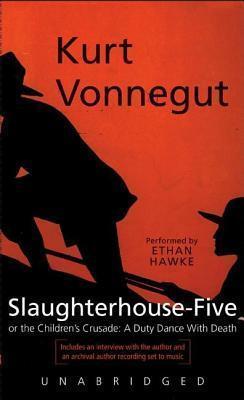
Slaughterhouse-Five is not only Vonnegut's most powerful book, it is also as important as any written since 1945. Like Catch-22, it fashions the author's experiences in the Second World War into an eloquent and deeply funny plea against butchery in the service of authority. Slaughterhouse-Five boasts the same imagination, humanity, and gleeful appreciation of the absurd found in Vonnegut's other works, but the book's basis in rock-hard, tragic fact gives it unique poignancy -- and humor.
Boekdetails
Genres
Recensies
Bekijk Alles
I wish I had discovered Kurt Vonnegut a little earlier. It is astonishing how I've taken a course in American literature for three years in college, and still had never heard of him or had one of his books suggested for reading. But what can one do? Better late than never! So here I am at the close of 2021 discovering one of the greatest authors I have ever read. Before diving into the book, I think it is worth mentioning how Vonnegut is so easy to read without being shallow or limited on a psychological or a philosophical plane. Part philosopher, part poet, Vonnegut was, in fact, capable of addressing the central problem of modern life, namely to maintain dignity and exercise free will in a world overrun by death and destruction, and in which both science and religion are powerless. Slaughterhouse-Five is Vonnegut's sixth novel, and a return to his experiences in World War 2 and survival of the bombing of Dresden. Its nucleus is Billy Pilgrim, Vonnegut's fictional companion during the war, and his literary tool to convey a magnificent myriad of ideas, feelings, notions.. The book incorporates most of Vonnegut's common themes. One of these is the absurdity of war. Slaughterhouse-Five was, in fact, subtitled The Children’s Crusade: an allusion to the 1213 Roman Catholic army of children who either drowned on their way to Palestine (as they were told) or were sold as slaves in North Africa. Similarly, the soldiers in World War 2 are depicted in Vonnegut's novel as mere children, totally oblivious of any common cause behind their enlistment. They were simply thrust into destruction, and prompted to fight and die in a meaningless scheme that had to be gone through at the expense of so many innocent lives. The absurdity of the armed conflict borders on a grim irony in some sections of the narrative like the scene of Edgar Derby's execution for stealing a teapot from the ruins. This episode is extremely sad, since it calls attention to the inversed values during the war. In the midst of unimaginable atrocities the stealing of an abandoned teapot was then an offense punishable by death. The nature of reality and illusion is another central theme in the novel. The plot can serve as a psychological study of a shell-shocked soldier, and the subsequent symptoms of PTSD that changed his life once and for all. Throughout the book, we are taken from one setting to another following the time-travels of Billie Pilgrim, which are subtly explained at the end of the novel as being fantasies inspired by Sci-Fi novels. The atrocious episodes of the war proved to be too much for Billy, whose mind had created a safer cocoon in order to cope and survive. In the Tralfamadorian philosophy in regard to time and death, for instance, a defense mechanism against the fear of the latter can be noted with clarity. In this manner, the boundaries between reality and illusion are blurred to such an extent that Billy had confused the two for the greatest part of his life. The horror of humankind’s cruelty to itself is also dealt with in the novel, especially within the ranks of the American army whose members were as inimical to one another as they were to their enemies. The vision of life as an ironic construct is another influential idea that can be seen in the miraculous survival of Billy in comparison with the demise of his wife and companions. But in spite of all the dreary aspects of war, Slaughter-House Five is surprisingly a narrative of survival. Vonnegut does not give his readers a clear-cut answer neither in regard to the absurdity of war nor to that of life itself, but offers instead a friendly guidance throughout the path of discovery.

I had high expectations for 'Slaughterhouse-Five,' but I found the execution disappointing. While the anti-war and fatalistic themes are prevalent, their presentation feels fragmented and disjointed. The frequent shifts in time and perspective disrupt the narrative flow, making it challenging to fully engage with the story. Despite its important themes, the novel's execution undermines its impact.