

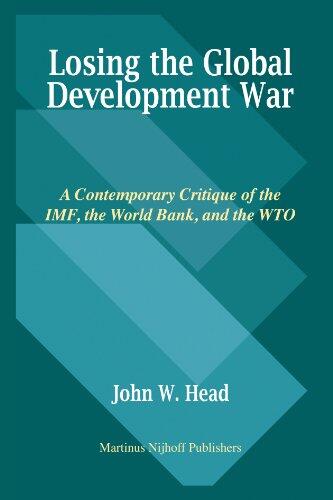
Szczegóły książki
Format
Miękka okładka
Strony
344
Język
Angielski
Opublikowany
Mar 15, 2008
Wydawca
Martinus Nijhoff Publishers
ISBN-10
9004161880
ISBN-13
9789004161887
Opis
In a thought-provoking analysis of modern economic structures, John W. Head delves into the operations and implications of major global institutions such as the International Monetary Fund, the World Bank, and the World Trade Organization. This examination reveals how these entities, often hailed as champions of global development, may instead perpetuate cycles of inequality and hinder sustainable progress.
Head meticulously critiques the prevailing ideologies that underpin these organizations, scrutinizing their policies and the broader impact on developing nations. By unpacking the complexities of international finance and trade, he highlights the disconnect between the lofty goals of poverty alleviation and the stark realities faced by marginalized communities.
Through detailed case studies and compelling arguments, the author challenges readers to reconsider the effectiveness of these institutions in fostering true economic growth. His insights urge a reevaluation of current practices, pushing for a paradigm shift that prioritizes equitable development.
This work serves as a clarion call for policymakers, activists, and scholars alike, prompting a rethinking of the frameworks that guide global economic governance. It invites a deeper dialogue on the pursuit of a just and sustainable world, effectively positioning itself as a critical resource for those concerned with the future of global development.
Head meticulously critiques the prevailing ideologies that underpin these organizations, scrutinizing their policies and the broader impact on developing nations. By unpacking the complexities of international finance and trade, he highlights the disconnect between the lofty goals of poverty alleviation and the stark realities faced by marginalized communities.
Through detailed case studies and compelling arguments, the author challenges readers to reconsider the effectiveness of these institutions in fostering true economic growth. His insights urge a reevaluation of current practices, pushing for a paradigm shift that prioritizes equitable development.
This work serves as a clarion call for policymakers, activists, and scholars alike, prompting a rethinking of the frameworks that guide global economic governance. It invites a deeper dialogue on the pursuit of a just and sustainable world, effectively positioning itself as a critical resource for those concerned with the future of global development.
Gatunki
Akcja i Przygoda