

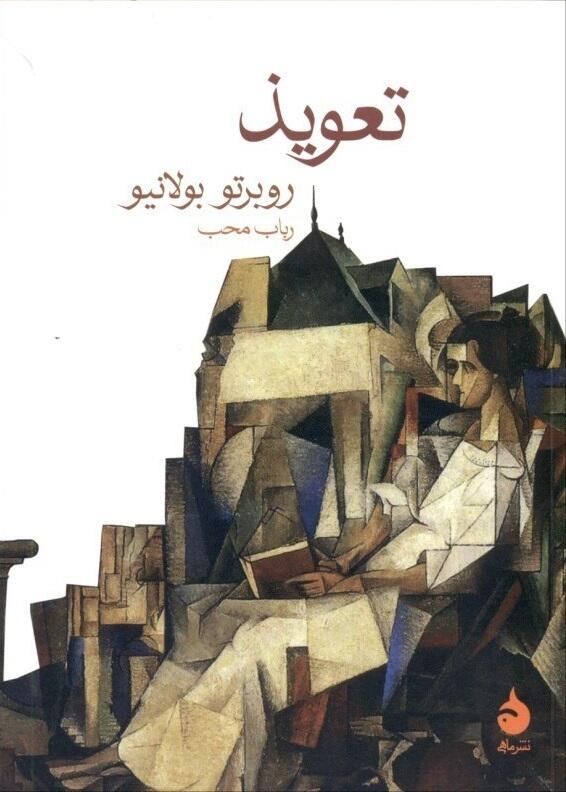
تعویذ
Opis
موضوعات عشق، هویت و جستجوی معنا در زندگی، محور اصلی این روایت است. هر کلمه و جمله به گونهای طراحی شده که خواننده را به تأمل در افکار و تجربیات شخصیتها دعوت کند. رباب محب و Roberto Bolaño در این اثر، ادبیاتی غنی و تأثیرگذار خلق کردهاند که خواننده را تحت تأثیر قرار میدهد.
فضای داستان با جزئیات فراوان، از رویدادهای تاریخی تا تأثیرات فرهنگی، تلطیف شده است. این اثر نه تنها داستانی جذاب را ارائه میدهد، بلکه فرصتی برای گفتگو درباره مسائلی عمیق و مهم در جامعه معاصر را فراهم میکند.
Recenzje

(...) and then we started walking along Avenida Guerrero, they a little slower than before, I a little more depressed than before, Guerrero, at that hour, resembles above all a cemetery, but not a cemetery of 1974, nor a cemetery of 1968, nor a cemetery of 1975, but rather a cemetery of 2666, a forgotten cemetery beneath a dead or unborn eyelid, the dispassionate saliva of an eye which, wanting to forget something, ended up forgetting everything." By Roberto Bolaño.
Amulet (Amuleto) is a novel by the Chilean writer Roberto Bolaño, first published in Spanish in 1999 in the Narrativas hispánicas collection by the Anagrama publishing house. The context of the book could be irrelevant, superfluous to read, manifested by a long abstract contemplation, for example: "Sometimes it was madness that drove me to travel. It’s possible I was mad, but I would argue that it was culture. Of course, culture is sometimes madness, or encompasses insanity. Sometimes it was lack of love that drove me to travel. Perhaps it was excessive, abundant love… Sometimes it was madness."
The novel is set in Mexico City and the year was 1968: in May '68, many young people in Latin America were victims of the Mexican disaster, a tragedy caused by French forces and which concluded with violence and death. Roberto Bolaño lived in Mexico for a few years. And Amulet, a tribute to an adopted country where he studied during his stay, was intended to denounce the catastrophe in a way that would redeem the chasm left by the dead.
This time, the Chilean poet Roberto found his alter ego in Auxilio Lacouture: in the brief initial self-portrait, Auxilio is a middle-aged Uruguayan woman who, in Amulet, investigates an atrocious and distant crime. She feeds on literature. And life, for this reason, encourages her, as it is her very essence. Her love for poetry and the poets who produce the verses she reads are her support.
The same story is perhaps told with a hint of irony towards the Europeans, because while they might have been at a bewildered gala dinner, the country where the incursion took place was a rather revolutionary season. Following an impetuous entry of the army into the campus, the protagonist locked herself in the university restrooms where she remained for several days. With her, apart from memories, she only had a book of poems by Pedro Garfias, and little by little she will reconstruct the history of a crime that marked the entire Latin American generation in the country. The fact is that Auxilio, with her own memories, jumps from the past to the future, a comprehensive framework that, even if supported by two references, allows the protagonist to evade a coherent novelistic structure. Yet, at the same time, when the figure of the prisoner locked in the restrooms seems to cease, the literal presence of Roberto Bolaño uses his cunning to create an inventive space so that he can add the extravagant and malformed to the narrative. Thus, in a way, one could suppose that the writer's shrewdness lies in using the concept of Dadaism where the Baroque reigns: a synthesis that is even in excess! In this context, the writer's expertise always prevails, who, with one difficult-to-understand sequence after another, when the horrifying narration manages to dissipate Auxilio's idea in the physical space, the writer's skill, in an almost real manner, recomposes the geography of where the event occurred.
Auxilio was alone, unable to ask for help. The easiest thing she could have done was to recall the years she had lived in Mexico and the days she still had left to live, but study and poetic love sustained her, and from these inclinations she received two references; the set of figurative conceptions present in the novel are moving in the field of language and moving away from certainties. In those moments of abandonment and solitude, as a first reference, she recalled Lilian Serpas, the poetess who made love with the revolutionary, guerrilla fighter, writer, and Argentine doctor Ernesto Rafael Guevara De la Serna (1928 – 1967), known simply as Che Guevara, to the unfounded children; she saw the poets León Felipe and Pedro Garfias, whom she considers two universal Spaniards, and besides being a great reader of poetry, she served Garfias as a voluntary housekeeper without ever telling him that she read his panting translations.
Subsequently, in the utopian narrative, at a certain point Auxilio Lacouture's main voice seems to split to return to being the alter ego of Arturo Belano; another fictitious character of the Chilean writer who is one of the main figures on multiple occasions in his texts. Out of that calm chaos, despite all the fears that could afflict her, the Uruguayan woman's second reference is a memory of recollections: a mental journey that begins with the most distant reminiscence and extends as far as she wants; although the novel intended to concentrate on Mexico, she knows well that not all excellent poets are Mexican. And he is aware of this, because in this sense, if the writer invented the alter ego of Arturo Baleno according to a Chilean person on other occasions, with Amulet the female figure Lacouture Auxilio draws upon the transfigured mother of Mexican poetry: from this second perspective raised by the memories, the writer wanted to pay tribute to Mexico with a female voice that simultaneously gave voice to the past catastrophes and the sorrows of a marvelous country. He, having studied for a few years in this land he loved so much, also knew well that the people who live there have a big heart in emotional terms, although they are part of that populace full of desires, without hope, and rich in dreams that are probably not achievable. Therefore, as part of the second reference, he highlights his protest for the Tlatelolco massacre and the consequence that the repression produced in an entire generation, which, according to the poetess, a country already destroyed did nothing but continue to degenerate.
Nevertheless, what remains of the narrative is always a symbolic and long dialogue of her own consciousness, fragmented memories, and encounters with acquaintances. Bearing in mind that, of the many conceptions that disrupt a coherent contemporary plot, perhaps it is Roberto Bolaño himself who, in Amulet, cannot get out of the Faculty of Literature and Philosophy: this is a noir, a terrifying story, of horror. Nonetheless, this kind of narration is an incipit to be used in an ideal anthology. In the case of Amulet, the topic may only function as a pretext to begin, sometimes even to dissipate, while on other occasions almost always to make literature in complete freedom. As a narrative example, the story is superfluous to the protagonists themselves who are being told about it, because ultimately they are not interested in the development of the plot, its conclusion, much less whether the planned predicament is resolved. Amulet, despite being a short novel, is full of interesting disintegrations that are linked to humanity, a good example of what Roberto Bolaño knew how to do. Probably a book that, on the part of the author, besides being intended as a tribute, involuntarily or maliciously, was also made to be commented upon. With his own skill, the Chilean writer sheds the melancholy of the years he lived in Mexico, and invites his readers to wander in the hand of Auxilio Lacouture, who, partly by being a female voice, proclaims herself as the mother of young Mexican poets: in this sense, she is the consciousness of Bolaño who will articulate political messages in the novel, but without doing politics even though it would have a high political content. He wanted to be a consciousness capable of planning a literary work that included political, mythological, historical, and various other issues, but which are enriched with a lot of humoral theory.
From a further analysis, one could also suppose a narcissistic concept because Auxilio Lacouture is a consciousness that analyzes, denounces, and projects itself onto events with the maternal soul belonging to that type of woman who embraces all human beings who want to be embraced. In essence, the true protagonist of Amulet remains an attractive language, and the detachment that Bolaño shows in it, this is because he is masterful: he chooses the correct and precise words, he handles the semantic-matrix with the poet's own intuition. And as a consequence of the same harmony, the rhythm of his prose, thanks also to the synthesis, is excess. There, in his prose, will be the source of pleasure for the reader, for him or those who will not escape the twists and turns of a craftsman of language, the plasticity of the structure, and his customary verbal play.
Dziennik czytania
Nie znaleziono dzienników czytania
Zacznij śledzić swój postęp w czytaniu, aby zobaczyć logi tutaj
Dodaj swój pierwszy dziennik czytaniaNotatki
Dziennik transakcji
Nie znaleziono dzienników transakcji
Zacznij śledzić swoje transakcje książkowe, aby zobaczyć logi tutaj
Dodaj swój pierwszy dziennik transakcji