

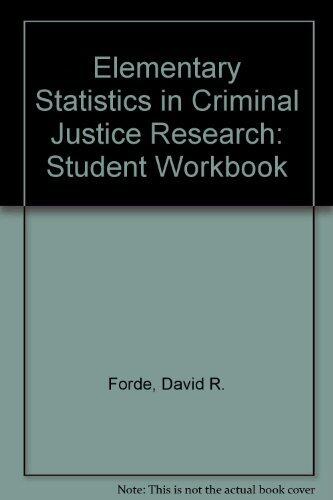
Szczegóły książki
Format
Miękka okładka
Strony
272
Język
Angielski
Opublikowany
Aug 30, 2004
Wydawca
Allyn & Bacon
ISBN-10
0205435149
ISBN-13
9780205435142
Opis
This comprehensive workbook is designed to enhance the learning experience of students delving into the crucial intersection of statistics and criminal justice. It complements the foundational concepts presented in the main text by providing practical exercises and applications relevant to real-world scenarios. Each chapter presents a variety of problems that challenge students to apply their theoretical knowledge to statistical methods used in criminal justice research.
Through engaging exercises, learners will explore topics such as data collection, hypothesis testing, and interpretation of statistical results. The workbook emphasizes the importance of quantitative analysis in understanding crime trends, evaluating criminal justice policies, and making data-driven decisions. The authors thoughtfully structure the material to ensure that students develop not only computational skills but also a deeper understanding of how statistics inform critical issues within the criminal justice system.
As students progress, they will encounter case studies and examples that illustrate the significance of statistical literacy in the field. These real-life applications demonstrate the relevance of statistics in tackling contemporary challenges faced by law enforcement and criminal justice professionals.
Overall, this workbook serves as an essential resource for students seeking to strengthen their grasp of elementary statistics while gaining valuable insights into its application in criminal justice. It is a tool that empowers future professionals with the skills they need to navigate and analyze the complexities of crime data.
Through engaging exercises, learners will explore topics such as data collection, hypothesis testing, and interpretation of statistical results. The workbook emphasizes the importance of quantitative analysis in understanding crime trends, evaluating criminal justice policies, and making data-driven decisions. The authors thoughtfully structure the material to ensure that students develop not only computational skills but also a deeper understanding of how statistics inform critical issues within the criminal justice system.
As students progress, they will encounter case studies and examples that illustrate the significance of statistical literacy in the field. These real-life applications demonstrate the relevance of statistics in tackling contemporary challenges faced by law enforcement and criminal justice professionals.
Overall, this workbook serves as an essential resource for students seeking to strengthen their grasp of elementary statistics while gaining valuable insights into its application in criminal justice. It is a tool that empowers future professionals with the skills they need to navigate and analyze the complexities of crime data.