

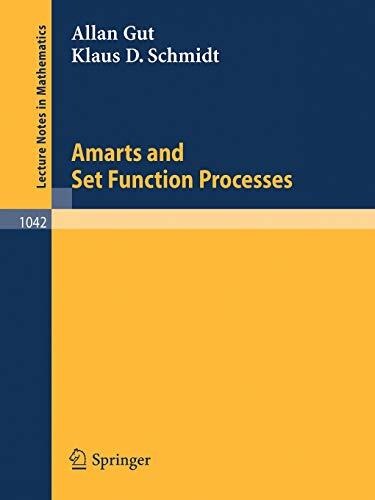
Детали книги
Формат
Мягкая обложка
Страницы
260
Язык
Английский
Опубликовано
Oct 3, 2013
Издатель
Springer
Издание
1983
ISBN-10
3662135353
ISBN-13
9783662135358
Описание
This scholarly work delves into the intricate world of amarts and set function processes, providing a comprehensive exploration of their theoretical foundations and practical implications. The authors, Klaus D. Schmidt and Allan Gut, bring substantial expertise, merging mathematical rigor with accessible explanations, making the complex subject matter approachable for readers with an interest in advanced probability and stochastic processes.
As the text unfolds, readers are guided through a structured examination of amarts—a concept integral to understanding certain stochastic processes. The authors meticulously outline definitions, properties, and examples that illustrate the relevance of amarts in various mathematical contexts. Their approach fosters comprehension, encouraging readers to engage with the material critically.
The study also touches upon applications and implications of set function processes, elucidating how these mathematical structures connect to real-world scenarios. By weaving together theoretical insights and practical considerations, Schmidt and Gut broaden the scope of knowledge for both novices and seasoned scholars alike.
Ultimately, this work serves as a valuable resource for researchers and students, cementing its place as an important contribution to the mathematical literature on stochastic processes and their applications.
As the text unfolds, readers are guided through a structured examination of amarts—a concept integral to understanding certain stochastic processes. The authors meticulously outline definitions, properties, and examples that illustrate the relevance of amarts in various mathematical contexts. Their approach fosters comprehension, encouraging readers to engage with the material critically.
The study also touches upon applications and implications of set function processes, elucidating how these mathematical structures connect to real-world scenarios. By weaving together theoretical insights and practical considerations, Schmidt and Gut broaden the scope of knowledge for both novices and seasoned scholars alike.
Ultimately, this work serves as a valuable resource for researchers and students, cementing its place as an important contribution to the mathematical literature on stochastic processes and their applications.