

Opis
Szczegóły książki
Gatunki
Recenzje
Zobacz wszystkie
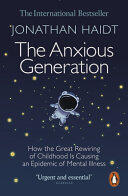
This book has been interesting - it's made me feel very uncomfortable knowing that I am essentially addicted to my phone. Even whilst reading this book I found myself reaching for it, checking. For what? I don't know. However I don't think it has taught me anything I didn't know - it has just made me think and face a few things a little more.The trouble with this book is I feel that it doesn't really do a great deal to really help. It can be repetitive and I don't feel really digs deep enough. There was a whole chapter on spirituality which I skipped as it felt far too much like his personal opinion rather than anything actually relevant. His basic premise is that since the introduction of smart phones, social media that more young people are feeling depressed and anxious. Haidt writes from a perspective of "back in my days/the good old days" which I think takes away some credibility. Some of the scientific research he admits is on shaky ground - which he dismisses in favour of his own opinion. Now - I think we will all agree that too much screen time for kids is not a good thing in isolation. And social media is no replacement of in-person communication especially with young people. Yet I feel Haidt over-simplifies it as just "all social media is bad" and doesn't delve much deeper than this. I think most parents will be aware of this, even if they don't always act on it. It is hard to when we are all probably a little too dependent on our own phones ourselves. I think many parents are not aware of the benefits of risky play and I would agree that "safetyism" is very detrimental to young people, probably more so than a phone. Risky play is allowing your kids to climb, to fall down, to get minor scrapes and cuts and bruises and explore their environment. Allowing your kids to climb, jump and make their own judgements. Schools need to allow more time for free-play and that children's lives shouldn't be taken up with homework and academic study - at least not until they are older. Overall - I think this is a good book to read - but it is not the complete story.

I have so much to say about this book. I read it months ago, but am finally ready to review. This is a must read for parents, especially millenials and older, as we just didn't live the same childhood our kids are living. The internet wasnt in our home until middle school. I didn't get a smartphone until college. We had myspace and livejournal and that didnt even come out until high school. I didnt read this book last year because I thought it was just going to demonize screen time, which is an idea I just don't subscribe to; however, that is not at all what is being said here. I found myself agreeing with so much. First, I think resiliency is the most important thing we all need entering adulthood. Haidt argues that many parents of late are helicoptering and overprotective and stifle kids' independence. Kids need to experience things for themselves, be allowed to make mistakes, and deal with social discomforts. He also makes a compelling case for us as a community to facilitate in person social interactions, sports or arts programs, and plenty of unstructured playtime. Learning how to deal with boredom is an important skill! There are things I didn't love. He had a LOT of commentary about how different boys and girls are in responding to social media. I mean, some of that may be true as a generalization; however, I think it was a bit too much time dedicated to how differently the genders perceive and react. Boys can be affected by portrayals of image and unfair comparisons and girls can be sucked into passive entertainment, p*rn, and doom scrolling. I also think he could have left out his commentary on transgender youth. While it is possible there is some group think going on in some circles, in our current climate, I just dont think giving space to that kind of rhetoric is useful, and can be harmful even. The same point could have been made without even mentioning transgender kids at all. That being said, I did appreciate how this book was laid out and organized and how well researched it was. I have read a lot of parenting books and this had by far the most scientific merit. I also appreciate a book about older kids. I think this is, like many parenting books, where you have to take what you like and leave the rest. What I am taking: keeping my kids involved in activities with other kids, creating a community of like minded families (because as he talks about this major societal change, I just don't think it is going to happen), letting my kids take risks and solve their own problems, encouraging responsibility (this is where I need the most work as a parent), talking to my kids as they get older about the dopamine loop and the science of addiction, and talking to them about reality vs the internet (p*rn and insta models are like the WWE of sex as compared to real life). So if you see me reading on a bench at the playground instead of following my kids around, know it is for a purpose, and not that I am a lazy mom (although there could be an argument for that as well). What I am going to leave: gendered language, hard and fast age based rules about media (no phones until high school and no social media until 16 - not sure how realistic or necessary that is), hoping schools and government will change. Basically I am not going to demonize technology. I will celebrate the richness of a life spent outdoors with meaningful friendships full of shared empathy. I will celebrate the joy and sense of calm that comes with accomplishing things with your hands and body. I will celebrate the pride and inner growth that comes from dealing with adversity, small or large.