

Book Details
Format
Paperback
Pages
267
Language
English
Published
Dec 16, 2011
Publisher
Springer
Edition
Softcover reprint of the original 1st ed. 1998
ISBN-10
364280330X
ISBN-13
9783642803307
Description
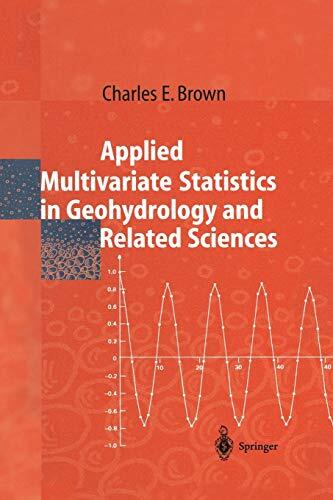
This exploration into the realm of multivariate statistics offers an essential foundation for understanding complex data sets in geohydrology and related environmental sciences. The author guides readers through various statistical techniques, emphasizing their application in analyzing and interpreting intricate relationships within geological and hydrological data.
By marrying theoretical concepts with practical applications, the work elucidates how multivariate methods can improve decision-making in environmental assessments and resource management. Readers will find relevant examples and case studies that showcase the effectiveness of these statistical tools in real-world scenarios.
The narrative is approachable yet rigorous, designed to cater to both seasoned professionals in the field and newcomers eager to expand their knowledge. As environmental challenges grow increasingly intricate, understanding these statistical methods becomes paramount, ensuring that researchers and practitioners can draw meaningful conclusions from their analyses.
Overall, this comprehensive guide serves as a valuable resource, encouraging a deeper appreciation for the role of advanced statistics in shaping sustainable practices within geohydrology and its associated disciplines.
By marrying theoretical concepts with practical applications, the work elucidates how multivariate methods can improve decision-making in environmental assessments and resource management. Readers will find relevant examples and case studies that showcase the effectiveness of these statistical tools in real-world scenarios.
The narrative is approachable yet rigorous, designed to cater to both seasoned professionals in the field and newcomers eager to expand their knowledge. As environmental challenges grow increasingly intricate, understanding these statistical methods becomes paramount, ensuring that researchers and practitioners can draw meaningful conclusions from their analyses.
Overall, this comprehensive guide serves as a valuable resource, encouraging a deeper appreciation for the role of advanced statistics in shaping sustainable practices within geohydrology and its associated disciplines.
Genres
Science & Technology