

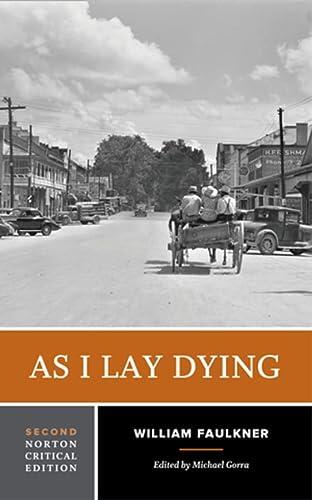
Book Details
Description
Accompanied by critical essays and insights that enhance the reading experience, this edition not only showcases Faulkner's innovative use of stream-of-consciousness but also provides context and analysis that illuminate the era and circumstances surrounding the book's creation. The layered perspectives of the Bundren family members confront the reader with a poignant exploration of grief, familial bonds, and the struggle against the forces of time and mortality.
Genres
Reviews
View All
This time, William Faulkner is described in the reader's eyes as a genius of imagination. Not so much for a poetic faculty, because better poets than him exist in abundance, especially in the poor areas of Latin America where young people have more hidden dreams than opportunities to realize fantasies. Obviously, Faulkner, as a poet, screenwriter, and novelist, left no doubt about having a literary talent: I express this because I do not believe that strokes of genius come from nothing. The individual might have a vocation. The certain thing is that any imaginary and material creativity always involves a long process of learning. In the case of the Nobel Prize in Literature winner, the rule is confirmed by writing without restrictions, free in its context, and firm with the present moment.
However, a controversy arose around the author himself regarding the adjective "literal" because the times he was told his prose was written literally, Faulkner disagreed. His thought was that he was just a writer. In this specific field, the author made it clear that for a literary attribution, it would be preferable for the interested party to read the critics' reviews. According to an interview the author granted, since he was only a writer, he could not have enough time to read the critiques written about him.
The author demonstrates his capacity once again. The result of mental freedom: in the case of this book, having composed it in less than two months, it is understandable that the writer's talent is above all a necessity of life. The novel features a very free text. If one wishes, it is also freed from the family unit, which in its context would be the straitjacket of the story. The tale is full of attention. Furthermore, the draft was written with some practical skill and not with a real technique. It brings together a whole series of closely linked figures: this is to introduce the mother's death within a family unit. From that moment on, the spouse feels a genuine need to transport the corpse to the family's place of origin.
Everything starts from nothing. The author had the reference of a roof in the middle of a field under which to give space to imagination: the barn in the middle of a field is not even the introductory part where the story began. What most affected the protagonist's serenity was the sound of a saw inside it. Meanwhile, poetic prose is not lacking throughout the narrative: dissolved poetic prose that recalls the primary need of every individual. That is, water. The essential need to drink. Or who knows, sometimes the need to cry, perhaps due to a nostalgic reminiscence. For example:
"As a boy, I learned that water tastes much better when it has been in a bucket for a while. Eager, with a taste slightly reminiscent of the July wind through the cedars. [...] And at night it is better. I always lay on the straw, waiting for everyone to fall asleep to get up and run to the bucket."
It is rhetorical to rewrite. I will highlight what is incomprehensible to my agnostic atheist morality. But I wonder if a thinker like the author could be faithful. In his writings, he often mentions the name of god: something he does by writing the supposed creator's name with a capital D, as if he were a devout Christian. The fact is that Faulkner reveres god, and with the characters, he alludes to mockery, for example:
"I'm not saying I'm religious, but I have a quiet conscience. Maybe a safe one. I've done some foolish things, but nothing worse or better than those who say the opposite. And I know that the Lord will think of me like any sparrow fallen from its nest."
Page after page, as events pile up, the female subject who will die and who inspired the book's title is introduced. For example, with this excerpt of dialogue:
- Are you sick, Addie?
- I don't have anything.
- Stay in bed a while. I knew you didn't have anything. You're a little tired. Rest for a while.
- I'm not sick. I'll get up.
- Stay a while. You're a little tired. Sleep for a little bit.
It seems evident that in this monologue, it is the author who needed to rest. There is a delirious communication between the two subjects. On the other hand, it is understandable that he decided to write the book in the summer of 1929 in only six weeks: he wrote it during a period that coincided with the night rest where he worked for a power plant. Everything becomes inherent to what Faulkner thought of composing: during an interview, the author said that he was able to write the novel quickly because he immediately had the concept of printing in mind.
The concept of death exists in the story. If you wish, the novel's summary could hold a profound philosophical reflection: the end of a life. But this is not the point either. This ending will prove to be a new beginning for the widower. In the narration, this death serves to separate from the introductory part of the story and begin to diverge alongside the title "As I Lay Dying." It is precisely when the protagonist goes to cover his companion lying in bed that the spouse realizes the wife is dead.
From the moment there is a corpse in the house, everything becomes bigger. The noise of the saw cutting wooden logs becomes a deafening noise. A depressive state begins to prevail in the protagonist's mind. With this noise, all configurations around him are amplified. Even the smell of hay becomes repugnant. From his demoralizing moral state, he perceives the need to cry and expresses it with poetic prose:
"The dead, hot, pale air blows on my face again. I could fix everything if I wanted to, but the air does not know this. [...] It rests on me, hot and dead. Touching my nakedness through the clothes. The air does not know what it means to worry. I don't know its meaning either. I don't know if I worry or not, if I can. If I can cry or if I can’t cry. I don't even know if I tried to cry or not. But I seem to be a wet seed lost in a blind and burning earth."
It is evident that the suffering in him was fierce: when the coffin was ready, they put his wife inside. But the husband knows that for a long time he will not be able to talk! Because, in that inconstancy where everything is greatly amplified, he saw the darkness leave in his mind: in reality, this impression alludes to a rebirth. Inside the family barn and with the saw that made a deafening noise in a moment of low spirits, the coffin was quickly built to insert this dead protagonist: they did not delay in completing the work with one last nail. Both for the box and the lid. It was finished before the dawn of a new day.
The widower assumed the role of a family man. In that situation, he will reveal himself with the sole need to rebuild a life together with another woman. There is no longer any form of delirium caused by the loss of an affection. There is no agonizing form for the main character. In any case, this father will emerge victorious by introducing a new companion to his offspring. Without hiding that it was he who stole the teeth from his blind companion.
They decided to put the deceased inside the coffin. He dressed the corpse's body in the wedding dress. Inside the coffin, the dead woman was placed with her feet where her head should be so that the dress wouldn't wrinkle. They had to go to Jefferson. A journey that would have taken two or three days by cart: inevitably, in this other case, when the road to the destination began to descend, the coffin began to escape from the cart. As if it were a sled in the snow. They couldn't stop it and let the coffin stop by itself: with the coffin box uncovered, the deceased was there. Turned to look at her husband, with her face distorted by anger and despair. As if she were saying to her spouse: "Go to hell. Go to hell!"
However, besides being a deceased body, this provocation inflicted by his ex-wife was not great. The expression of the dead woman bothered the widower, even if it belonged to a person now extinct. The husband was aware that when she was alive, his companion admitted she was not a saintly woman. To conclude, being insulted from the coffin, the widower made an imposition of pride. Allowing all the surrounding events and situations that occurred to be nothing more than a page of the past to be rewritten: as if nothing had happened, he will arrive at the family in Jefferson with the horse-drawn cart, the dead woman, and a new companion.
This time, William Faulkner is described in the reader's eyes as a genius of imagination. Not so much for a poetic faculty, because better poets than him exist in abundance, especially in the poor area of Latin America where young people have more hidden dreams than possibilities to realize fantasies. Obviously, Faulkner as a poet, screenwriter, and novelist left no doubt of having had a literal talent: I express this because I don't believe that strokes of genius come from nothing. The subject could have a vocation. The truth is that any imaginary and material creativity always involves a long process of learning. In the case of the Nobel Prize in Literature winner, the rule is confirmed by a writing that is unrestricted, free in its context, and firm with the current moment.
However, a controversy arose around the author himself with the adjective literal because the times he was told that he wrote the prose literally, Faulkner disagreed. His thought was that he was only a writer. In this specific field, the author had the clear idea that for a literal attribution, it would be preferable for the interested party to read the readers' reviews. According to an interview the author granted, since he was only a writer, he couldn't have enough time to read the reviews that had been written about him.
The author once again shows his capacity. The result of a mental freedom: in the case of this book, having composed it in less than two months, it is understandable that the writer's talent is first and foremost a necessity of life. The novel has a very free text. If desired, it is also liberated from the family unit, which in its context would be the straitjacket of the story. The tale is full of details. Furthermore, the draft was written with some practical skill and not with a real technique. It brings together a whole series of well-connected figures: this to introduce the death of a mother within a family unit. From that moment, on the part of the spouse, there is the sincere need to take the corpse to his family's place of origin.
It all starts from nothing. The author had the reference of a roof in the middle of a field under which to give space to the imagination: the barn in the middle of a field is not even the introductory part where the story began. What most influences the protagonist's serenity was the sound of a saw inside it. Meanwhile, poetic prose is not lacking throughout the narrative: dissolved poetic prose that recalls the primary need of every individual. That is, water. The essential need to drink. Or who knows, sometimes the need to cry, perhaps due to a nostalgic reminiscence. For example: "When I was a child, I learned that water carries a much better taste when it has been in a bucket for a while. Eager, with a flavor that slightly recalls the July wind among the cedars. [...] And at night it is better. I was always lying on the straw, waiting for everyone to fall asleep to get up and run to the bucket."
It's rhetorical to rewrite. I will highlight what is incomprehensible to my morality as an agnostic atheist. But I wonder if a thinker like the author could be faithful. In his writings, he often mentions the name of God: something he does by writing the name of the supposed creator with a capital G, as if he were a devout Christian. The fact is that Faulkner venerates God, and with the characters, he alludes to a mockery, for example: "I ain't saying I'm religious, but I got a clear conscience. Maybe a safe one. I done some foolish things, but set facing those that say different nothing worse or better. And I know the Lord will think of me just like any sparrow that fell out of the nest."
Page after page, as the events accumulate, the female subject who will die and who inspired the book's title is introduced. For example, with the piece of dialogue:
- Are you sick, Addie?
- I ain't got nothing.
- You lay there a while. I knowed you didn't have nothing. You just tired a little. You rest a while.
- I ain't sick. I'm going to get up.
- You lay there a while. You just tired a little. You sleep a little while.
It seems evident that in this monologue it is the author who would have needed to rest. There is a delusional communication between the two subjects. On the other hand, it is understandable that he decided to write the book in the summer of 1929 in only six weeks: he wrote it during a period that coincided with the nightly rest when he worked at a power plant. Everything becomes inherent to what Faulkner thought about composing: during an interview, the author said that he was able to write the novel in a short time because he immediately had the concept of printing in mind.
There is the concept of death in the story. If you wish, the summary of the novel could have a profound philosophical reflection: the end of a life. But this isn't the point either. This ending will prove to be a new beginning for the widower. In the narration, this death serves to separate from the introductory part of the story and begin to pivot towards the title, "As I Lay Dying." It is precisely when the protagonist goes to cover his partner lying in bed that the spouse realizes his wife is dead. From the moment there is a corpse in the house, everything becomes bigger. The noise of the saw cutting wooden logs becomes deafening noise. A depressive state begins to prevail in the protagonist's mind. With this noise, all the configurations around him are amplified. Even the smell of hay becomes repugnant. From his demoralizing moral state, he perceives the need to cry and expresses it with poetic prose: "The dead air, hot and pale, blows again on my face. I could fix all if I would, but the air don't know it. [...] It lays on me, hot and dead. Touching my nakedness through my clothes. The air don't know what it is to worry. I don't know what it is to worry. I don't know if I am worrying or not, if I can. If I can cry or not. I don't even know if I tried to cry or not. But it seems to me like a wet seed in a blind and arid earth."
It is evident that the suffering in him was fierce: when the coffin was ready, they put his wife inside. But the husband knows that he won't be able to speak for a long time! Because, in that inconstancy where everything is greatly amplified, he saw the darkness leave in his mind: in reality, this impression alludes to a rebirth. Inside the family barn and with the saw that, in a moment of poor morale, made a deafening noise, the coffin to insert this dead protagonist was quickly built: they did not delay in completing the work with a last nail. Both for the box and for the lid. It was finished being built before the dawn of a new day.
The widower assumed the role of a family man. In that situation, he will reveal himself with the sole need to rebuild a life with another woman. There is no longer any form of delirium caused by the loss of affection. There is no agonizing form for the main character. In any case, this family father will emerge victorious by introducing a new partner to his offspring. Without hiding that it was he who stole the teeth from his blind companion.
They decided to put the deceased inside the coffin. The corpse's body was dressed in its wedding dress. Inside the coffin, the dead woman was placed with her feet where her head should be so that the dress would not wrinkle. They had to go to Jefferson. A trip that would have taken two or three days with a wagon: inevitably, in this other instance, when the path to the destination began to descend, the coffin started to slip out of the wagon. As if it were a sled in the snow. They couldn't stop it and let the coffin stop on its own: with the coffin lid open, the deceased was there. Turned to look at her husband, her face distorted by anger and despair. As if she were saying to her spouse: "Go to hell. Go to hell!"
However, besides being a deceased body, this provocation inflicted by his ex-wife was not a great thing. The expression of the dead woman bothered the widower, even if it belonged to a person now extinct. The husband was aware that when she was alive, his partner admitted that she was not a saint. Finally, being insulted from the coffin, the widower made an imposition of pride. Allowing all the surrounding events and situations that occurred to be nothing more than a page of the past to be rewritten: as if nothing had happened, he will arrive at the family in Jefferson with the horse-drawn cart, the dead woman, and a new partner.