

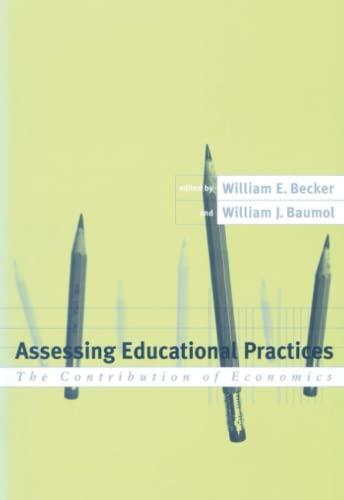
Book Details
Format
Paperback
Pages
296
Language
English
Published
Apr 29, 2013
Publisher
MIT Press
ISBN-10
0262519690
ISBN-13
9780262519694
Description
In a thought-provoking exploration of the intersection between economics and education, this work invites readers to consider how economic principles can inform and enhance educational practices. With insightful analysis, the author delves into the underlying economic factors that influence educational outcomes and the decisions made within educational institutions.
By examining a variety of educational practices through the lens of economic theory, the narrative encourages educators and policymakers to think critically about resource allocation, efficiency, and the impact of financial decisions on student learning. The discussion moves beyond theoretical frameworks, as real-world applications and case studies are woven throughout, providing practical insights into how economic concepts can be utilized in educational contexts.
As educational systems face mounting pressures to optimize results and justify funding, the book presents a compelling case for the integral role of economic assessment in developing effective strategies that support student success. Through rigorous evaluation, it highlights the potential for improved educational practices that not only respond to immediate needs but also anticipate future challenges.
Overall, this work stands as a significant contribution to the field, fostering a deeper understanding of how economics can serve as a valuable tool in shaping educational policies and practices. It aims to inspire a reevaluation of current approaches, urging stakeholders to adopt a more economically informed perspective to advance educational quality and accessibility.
By examining a variety of educational practices through the lens of economic theory, the narrative encourages educators and policymakers to think critically about resource allocation, efficiency, and the impact of financial decisions on student learning. The discussion moves beyond theoretical frameworks, as real-world applications and case studies are woven throughout, providing practical insights into how economic concepts can be utilized in educational contexts.
As educational systems face mounting pressures to optimize results and justify funding, the book presents a compelling case for the integral role of economic assessment in developing effective strategies that support student success. Through rigorous evaluation, it highlights the potential for improved educational practices that not only respond to immediate needs but also anticipate future challenges.
Overall, this work stands as a significant contribution to the field, fostering a deeper understanding of how economics can serve as a valuable tool in shaping educational policies and practices. It aims to inspire a reevaluation of current approaches, urging stakeholders to adopt a more economically informed perspective to advance educational quality and accessibility.
Genres
Romance
Business & Economics