

Description
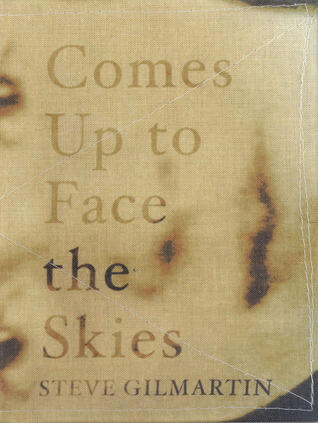
Derived from his own mistranslation of Emily Dickinson poems in German, "Comes Up to Face the Skies" sends the reader down the rabbit hole of the translator. Each poem set contains a series of three interpretations in which the poet experiments with the meaning of the original text, sometimes resurrecting his own faulty German, but more often exploiting those flaws to send the poem spinning off in a completely novel and unforeseen direction.
Gilmartin’s stretching of Dickinson’s poems compels us to abandon any conception of a stable source text. He alters line numbers and stanza breaks, turning “I dwell in possibility” into a slab sonnet. He transforms “Dots, / On a Disk of Snow” into “nymph exoskeletons” and then “a slow-motion sneeze.” What we get, as a native speaker translates poems back into their native language through a foreign filter, is really a commentary on the fidelity of language. And so when the poet asks, “must words arrange to marry?” his poems suggest we answer, “No—they are not.”
Gilmartin’s stretching of Dickinson’s poems compels us to abandon any conception of a stable source text. He alters line numbers and stanza breaks, turning “I dwell in possibility” into a slab sonnet. He transforms “Dots, / On a Disk of Snow” into “nymph exoskeletons” and then “a slow-motion sneeze.” What we get, as a native speaker translates poems back into their native language through a foreign filter, is really a commentary on the fidelity of language. And so when the poet asks, “must words arrange to marry?” his poems suggest we answer, “No—they are not.”
Book Details
Format
Paperback
Pages
18 pages
Language
English
Published
Mar 1, 2013
Publisher
LRL textile series / Dawn Pendergast