

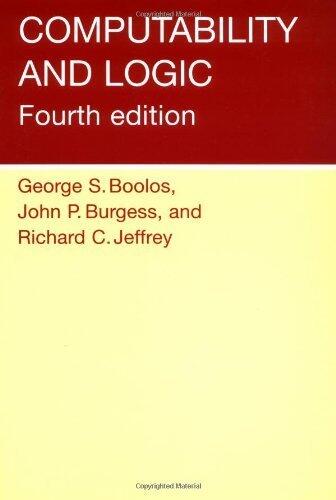
Description
This work delves into the intertwined realms of computability theory and logic, presenting complex ideas with clarity. The authors elegantly break down the foundational concepts that underlie mathematical logic, highlighting the significant contributions of computability to understanding formal systems. Their engaging approach invites readers to explore the nature of mathematical problems and the limits of computable functions, shedding light on theoretical aspects that resonate with both novice and experienced scholars.
Through a careful blend of rigorous argumentation and accessible exposition, the book encourages critical thinking about the implications of logical frameworks in mathematics. Readers are guided through intricate questions about truth, proof, and the capabilities of algorithms, fostering a deeper appreciation for the logical structures that govern computation. This intellectual journey reveals the profound connections between logic and computability, making it a valuable resource for anyone interested in the philosophy of mathematics.
Through a careful blend of rigorous argumentation and accessible exposition, the book encourages critical thinking about the implications of logical frameworks in mathematics. Readers are guided through intricate questions about truth, proof, and the capabilities of algorithms, fostering a deeper appreciation for the logical structures that govern computation. This intellectual journey reveals the profound connections between logic and computability, making it a valuable resource for anyone interested in the philosophy of mathematics.
Book Details
Format
Paperback
Language
English
Publisher
Cambridge University Press; 4 edition (2002-03-04)
Editions
2 editions