

Description
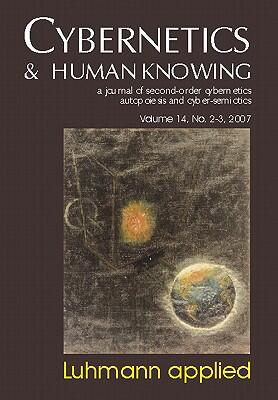
This volume delves into the intricate relationship between cybernetics and human understanding, showcasing the applications of second-order cybernetics through the lens of prominent theorist Niklas Luhmann. It offers a unique exploration of autopoiesis, a concept that refers to the self-reproducing nature of systems, which is integral to both living organisms and social systems.
Readers will find an engaging collection of articles that examine how Luhmann's work can be interpreted and applied within the context of cybernetics. The contributors to this issue reflect on the theoretical implications of Luhmann's ideas, linking them to contemporary problems in social theory and systems thinking. This discourse fosters a dialogue that invites readers to reconsider established notions of knowledge and interaction.
The articles blend rigorous academic inquiry with practical examples, demonstrating the relevance of Luhmann’s theories in today’s rapidly evolving technological landscape. This rich interdisciplinary approach makes the volume a vital resource for scholars, practitioners, and anyone interested in the intersections of systems theory, social dynamics, and human cognition.
Ultimately, this issue serves as a platform for advancing discussions in second-order cybernetics, challenging readers to rethink how we understand communication and knowledge generation within complex systems. It highlights the ongoing importance of Luhmann’s insights in navigating the complexities of contemporary society.
Readers will find an engaging collection of articles that examine how Luhmann's work can be interpreted and applied within the context of cybernetics. The contributors to this issue reflect on the theoretical implications of Luhmann's ideas, linking them to contemporary problems in social theory and systems thinking. This discourse fosters a dialogue that invites readers to reconsider established notions of knowledge and interaction.
The articles blend rigorous academic inquiry with practical examples, demonstrating the relevance of Luhmann’s theories in today’s rapidly evolving technological landscape. This rich interdisciplinary approach makes the volume a vital resource for scholars, practitioners, and anyone interested in the intersections of systems theory, social dynamics, and human cognition.
Ultimately, this issue serves as a platform for advancing discussions in second-order cybernetics, challenging readers to rethink how we understand communication and knowledge generation within complex systems. It highlights the ongoing importance of Luhmann’s insights in navigating the complexities of contemporary society.
Book Details
Format
Paperback
Pages
200 pages
Language
English
Published
Apr 1, 2008
Publisher
Imprint Academic
Edition
Illustrated
ISBN-10
1845401484
ISBN-13
9781845401481