

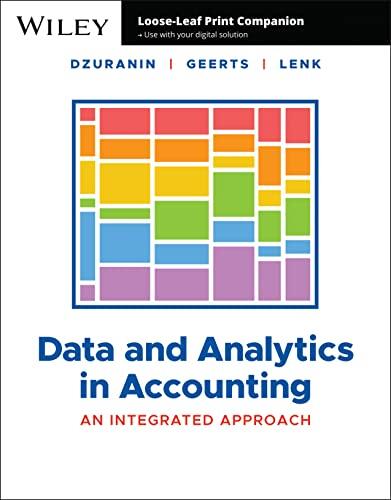
Book Details
Format
Paperback
Pages
656
Language
English
Published
Dec 20, 2022
Publisher
Wiley
Edition
1
ISBN-10
1119722993
ISBN-13
9781119722991
Description
The authors present a comprehensive examination of how data and analytics are reshaping the accounting profession. They delve into the intersection of technology and financial practices, illustrating how modern accounting is increasingly reliant on data-driven decision-making. With this integrated approach, professionals are better equipped to navigate complexities in financial reporting and auditing.
Through a blend of theoretical insights and practical applications, the text urges accountants to embrace these emerging technologies. The authors emphasize the importance of analytics skills as a vital asset, empowering practitioners to extract value from data and improve organizational performance. Their discussion extends beyond mere numbers, focusing on real-world scenarios that showcase the potential for enhanced strategic planning and risk management.
Furthermore, the book addresses the ethical considerations that arise in the realm of data usage. It prompts readers to reflect on the implications of their work, ensuring that accountability and integrity remain at the forefront of the profession. The narrative highlights the growing necessity for accountants to not only be proficient in financial principles but also adept at interpreting and leveraging data effectively.
Overall, this exploration of data and analytics demonstrates a forward-thinking vision for the accounting field, illustrating how these tools can lead to more informed decisions and better business outcomes. The authors advocate for a future where accountants are equipped with the skills to thrive in an increasingly data-centric world.
Through a blend of theoretical insights and practical applications, the text urges accountants to embrace these emerging technologies. The authors emphasize the importance of analytics skills as a vital asset, empowering practitioners to extract value from data and improve organizational performance. Their discussion extends beyond mere numbers, focusing on real-world scenarios that showcase the potential for enhanced strategic planning and risk management.
Furthermore, the book addresses the ethical considerations that arise in the realm of data usage. It prompts readers to reflect on the implications of their work, ensuring that accountability and integrity remain at the forefront of the profession. The narrative highlights the growing necessity for accountants to not only be proficient in financial principles but also adept at interpreting and leveraging data effectively.
Overall, this exploration of data and analytics demonstrates a forward-thinking vision for the accounting field, illustrating how these tools can lead to more informed decisions and better business outcomes. The authors advocate for a future where accountants are equipped with the skills to thrive in an increasingly data-centric world.