

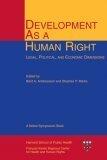
Description
In this work, the authors delve into the complex interplay between development and human rights, emphasizing that economic prosperity is intrinsically tied to the realization of human rights. They argue that true development cannot be achieved without acknowledging the legal, political, and economic dimensions that underpin human dignity. Through an array of case studies and theoretical frameworks, Marks and Andreassen elucidate how a rights-based approach to development can foster inclusive growth.
The authors call for a paradigm shift in how development is perceived and implemented, advocating for policies that prioritize human rights as fundamental to economic strategies. They highlight the necessity of legal frameworks that support the attainment of human development goals, reflecting on the significance of political will and governance in steering these initiatives. The narrative is underscored by a deep understanding of the socio-economic challenges that persist in various global contexts.
As they navigate the landscape of development, Marks and Andreassen present compelling arguments for collaboration among stakeholders, including governments, NGOs, and civil society. By addressing the root causes of inequality and injustice, they articulate a vision where development serves not merely as an economic endeavor but as a holistic approach that respects and enhances human rights for all individuals.
The authors call for a paradigm shift in how development is perceived and implemented, advocating for policies that prioritize human rights as fundamental to economic strategies. They highlight the necessity of legal frameworks that support the attainment of human development goals, reflecting on the significance of political will and governance in steering these initiatives. The narrative is underscored by a deep understanding of the socio-economic challenges that persist in various global contexts.
As they navigate the landscape of development, Marks and Andreassen present compelling arguments for collaboration among stakeholders, including governments, NGOs, and civil society. By addressing the root causes of inequality and injustice, they articulate a vision where development serves not merely as an economic endeavor but as a holistic approach that respects and enhances human rights for all individuals.
Book Details
Format
Paperback
Pages
350 pages
Language
English
Published
Jan 15, 2007
Publisher
FXB Center for Health and Human Rights
ISBN-10
0674021215
ISBN-13
9780674021211