

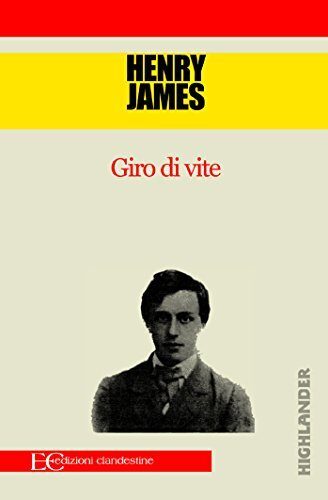
Description
A very young woman's first job: governess for two weirdly beautiful, strangely distant, oddly silent children, Miles and Flora, at a forlorn estate... An estate haunted by a beckoning evil. Half-seen figures who glare from dark towers and dusty windows- silent, foul phantoms who, day by day, night by night, come closer, ever closer. With growing horror, the helpless governess realizes the fiendish creatures want the children, seeking to corrupt their bodies, possess their minds, own their souls. But worse-much worse- the governess discovers that Miles and Flora have no terror of the lurking evil. For they want the walking dead as badly as the dead want them.
Excerpt:
I remember the whole beginning as a succession of flights and drops, a little seesaw of the right throbs and the wrong. After rising, in town, to meet his appeal, I had at all events a couple of very bad days - found myself doubtful again, felt indeed sure I had made a mistake. In this state of mind I spent the long hours of bumping, swinging coach that carried me to the stopping place at which I was to be met by a vehicle from the house.
Book Details
Genres
Reviews
View All
I was expecting a lot more out of this. I trod through the first part, hopelessly bored and not really liking the narrator much (she was crazy clingy with the children and very old-school-gothic-heroine, and I do not like those types) in the hopes that it would get creepy. I wanted it to be creepy. I wanted chills down my spine and to be left with a sense of horror when the ending came. I was not. Some of this might simply have been that my expectations were way too high. I normally try not to let that affect me, but it may very well have with this novel. I had heard such wonderful things about it, that it was a classic and that it was eerie and that it left you, in the end, with questions about the sanity of several people. I didn't feel like the sanity was really in question, honestly. There were no real questions for me, and while the ending did leave me with a vague sense of horror, it was not of the type one generally wishes to be engendered by a horror story. It was horror of a different sort, almost everyday horror, and that was not what I signed up for. Perhaps I missed something. Perhaps my hopes were too high and there was no way it could meet them, or perhaps I'm missing subtleties in the text, but I felt like this is vastly overrated as a horror story and I did not, in the end, like it very much.

An absorbing novella recently made into a drama series entitled The Haunting of Bly Manor (2020) with considerable changes to the plot but still a descent amount of mystery and horror. And yet, nothing equals the original work. The book, though very short, is far superior to the show; a spell-binding piece which immerses the reader in the mysteries and riddles overwhelming the characters. The novella can be read either as a very well crafted ghost story of the Gothic genre, or a modernist psychological investigation of an unstable mind. For the governess at Bly was either battling against malignant ghosts and supernatural forces, or projecting her own destructive feelings toward the children by means of imaginary phantoms. There is much to be said about Modernism in the novella. Its most prominent feature is arguably the unreliable narration of the tale. The story is told by an anonymous narrator who is only re-telling what his friend Douglas was reading to an assembled party from a particular manuscript. On the whole, there are three narrators with different understanding of the tale, and therefore with different interpretations. In this manner, the text insists upon the deceitfulness of perception, and leaves the existence or non-existence of ghosts at Bly to be read as a form of binary opposition. Fragmentation is another modernist technique that can be noted in the unachieved ending of the story. Instead of an answer to the riddle, the novella ends in silence; a blank meant to be supplied by the reader, who is free to judge whether the governess had suffocated Miles or had him die in her arms out of fear of ghosts, and by the same token decide whether the tale is a ghost story or a psychological case in which the ghosts of Miss Jessel and Peter Quint are neurotic delusions of the governess herself.