

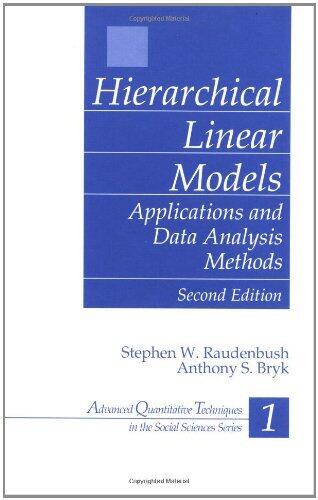
Description
This comprehensive guide delves into the complexities of hierarchical linear models, which are essential for understanding data that is organized at multiple levels. The author expertly illustrates how these models can be applied to various fields, particularly within the social sciences, where data often involves nested structures, such as students within schools or patients within clinics.
Through detailed examples and practical applications, the work serves as an invaluable resource for researchers and practitioners alike. It bridges the gap between theory and practice, providing readers with the tools necessary to analyze their data effectively while gaining a deeper insight into the hierarchical relationships present in their research.
Furthermore, the analysis methods discussed are accessible yet rigorous, making them suitable for advanced students and experienced researchers. By focusing on real-world applications, this guide ensures that readers can readily translate their learning into impactful outcomes in their respective studies.
Through detailed examples and practical applications, the work serves as an invaluable resource for researchers and practitioners alike. It bridges the gap between theory and practice, providing readers with the tools necessary to analyze their data effectively while gaining a deeper insight into the hierarchical relationships present in their research.
Furthermore, the analysis methods discussed are accessible yet rigorous, making them suitable for advanced students and experienced researchers. By focusing on real-world applications, this guide ensures that readers can readily translate their learning into impactful outcomes in their respective studies.
Book Details
Format
Hardcover
Language
English
Publisher
SAGE Publications, Inc