

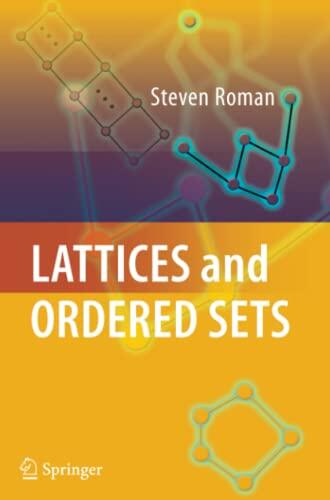
Description
This book is intended to be a thorough introduction to the subject of order and lattices, with an emphasis on the latter. It can be used for a course at the graduate or advanced undergraduate level or for independent study. Prerequisites are kept to a minimum, but an introductory course in abstract algebra is highly recommended, since many of the examples are drawn from this area. This is a book on pure I do not discuss the applications of lattice theory to physics, computer science or other disciplines. Lattice theory began in the early 1890s, when Richard Dedekind wanted to know the answer to the following Given three subgroups EF , and G of an abelian group K, what is the largest number of distinct subgroups that can be formed using these subgroups and the operations of intersection and sum (join), as in E?FßÐE?FÑ?GßE?ÐF?GÑ and so on? In lattice-theoretic terms, this is the number of elements in the relatively free modular lattice on three generators. Dedekind [15] answered this question (the answer is #)) and wrote two papers on the subject of lattice theory, but then the subject lay relatively dormant until Garrett Birkhoff, Oystein Ore and others picked it up in the 1930s. Since then, many noted mathematicians have contributed to the subject, including Garrett Birkhoff, Richard Dedekind, Israel Gelfand, George Grätzer, Aleksandr Kurosh, Anatoly Malcev, Oystein Ore, Gian-Carlo Rota, Alfred Tarski and Johnny von Neumann.
Book Details
Format
Paperback
Pages
320 pages
Language
English
Published
Oct 29, 2010
Publisher
Springer
Editions
3 editions
ISBN-10
1441927042
ISBN-13
9781441927040