

Description
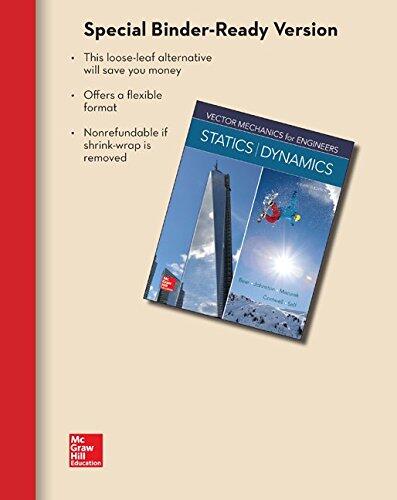
In a comprehensive exploration of vector mechanics, a team of esteemed authors delves into the principles of statics and dynamics, merging theory with practical application. The text is structured to enhance understanding and retention, utilizing a fluid narrative that guides readers through complex concepts with clarity and precision. Engaging examples and real-world scenarios breathe life into theoretical discussions, making the material accessible and relevant to both students and professionals.
The collaboration of Ferdinand Beer, E. Johnston, David Mazurek, and Phillip Cornwell results in a meticulously crafted resource, ideal for engineering students aiming to grasp the fundamentals of mechanics. The book encourages the development of problem-solving skills, offering a variety of exercises that challenge learners to apply their knowledge in innovative ways. Its intuitive layout complements its educational goals, making it a go-to reference for both classroom use and independent study.
Readers will find that the integration of practical applications throughout the chapters allows for a deeper appreciation of how vector mechanics plays a pivotal role in engineering disciplines. The authors emphasize the importance of visualization and logical reasoning, enabling students to cultivate a robust analytical mindset essential for future endeavors in engineering.
As a cornerstone in engineering education, this text stands as a lasting contribution to the discipline, equipping readers with the necessary tools to navigate the challenges of vector mechanics. By blending traditional learning approaches with modern pedagogical techniques, the authors ensure that this work remains relevant and invaluable to generations of engineers.
The collaboration of Ferdinand Beer, E. Johnston, David Mazurek, and Phillip Cornwell results in a meticulously crafted resource, ideal for engineering students aiming to grasp the fundamentals of mechanics. The book encourages the development of problem-solving skills, offering a variety of exercises that challenge learners to apply their knowledge in innovative ways. Its intuitive layout complements its educational goals, making it a go-to reference for both classroom use and independent study.
Readers will find that the integration of practical applications throughout the chapters allows for a deeper appreciation of how vector mechanics plays a pivotal role in engineering disciplines. The authors emphasize the importance of visualization and logical reasoning, enabling students to cultivate a robust analytical mindset essential for future endeavors in engineering.
As a cornerstone in engineering education, this text stands as a lasting contribution to the discipline, equipping readers with the necessary tools to navigate the challenges of vector mechanics. By blending traditional learning approaches with modern pedagogical techniques, the authors ensure that this work remains relevant and invaluable to generations of engineers.
Book Details
Format
Paperback
Pages
2,944 pages
Language
English
Published
Feb 16, 2015
Publisher
McGraw Hill
Edition
11
ISBN-10
0077687426
ISBN-13
9780077687427