

Description
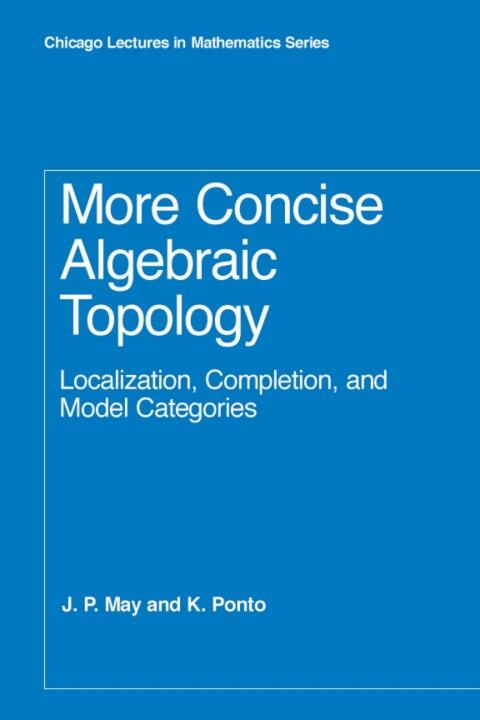
Algebraic topology, despite its relatively recent inception in the 1950s, has rapidly evolved into a profound field of mathematics that connects various areas of study. This work delves into the essential principles of this discipline, focusing on topics such as localization, completion, and model categories. The authors, J.P. May and K. Ponto, distill complex ideas into an accessible format, making it easier for readers to grasp the underlying concepts.
The exploration of localization offers new insights into how topological spaces can be understood through algebraic structures, empowering mathematicians to tackle intricate problems with renewed vigor. Completion serves as a bridge for connecting different mathematical frameworks, allowing for deeper analysis and understanding of anomalies within algebraic topology.
Model categories are also a central theme, providing a versatile framework that unifies various homotopical theories. The work encourages both seasoned mathematicians and newcomers to reflect on the interconnectedness of mathematical ideas, fostering an environment where collaboration and innovation could thrive.
By combining clear explanations with rigorous mathematical content, this book serves as an indispensable resource for those looking to enhance their knowledge of algebraic topology. It encourages readers to think critically and creatively, ensuring that the principles explored will resonate within the broader landscape of mathematics.
The exploration of localization offers new insights into how topological spaces can be understood through algebraic structures, empowering mathematicians to tackle intricate problems with renewed vigor. Completion serves as a bridge for connecting different mathematical frameworks, allowing for deeper analysis and understanding of anomalies within algebraic topology.
Model categories are also a central theme, providing a versatile framework that unifies various homotopical theories. The work encourages both seasoned mathematicians and newcomers to reflect on the interconnectedness of mathematical ideas, fostering an environment where collaboration and innovation could thrive.
By combining clear explanations with rigorous mathematical content, this book serves as an indispensable resource for those looking to enhance their knowledge of algebraic topology. It encourages readers to think critically and creatively, ensuring that the principles explored will resonate within the broader landscape of mathematics.
Book Details
Format
Kindle
Pages
514 pages
Language
English
Published
Jan 1, 2011
Publisher
University of Chicago Press
Edition
1
Editions
3 editions
ISBN-10
0226511790
ISBN-13
9780226511795