

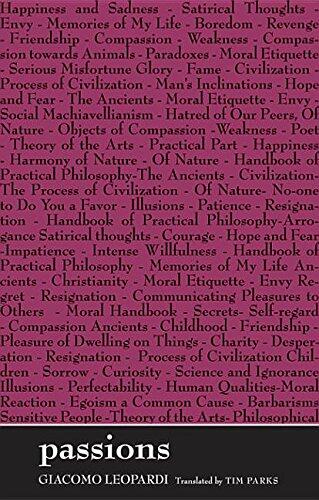
Book Details
Format
Kindle
Pages
232
Language
English
Published
Oct 7, 2014
Publisher
Yale University Press
ISBN-10
0300186606
ISBN-13
9780300186604
Description
Revenge—Revenge is so sweet one often wishes to be insulted so as to be able to take revenge, and I don’t mean just by an old enemy, but anyone, or even (especially when in a really bad mood) by a friend.—from Passions
The extraordinary quality of Giacomo Leopardi’s writing and the innovative nature of his thought were never fully recognized in his lifetime. Zibaldone, his 4,500-page intellectual diary—a vast collection of thoughts on philosophy, civilization, literary criticism, linguistics, humankind and its vanities, and other varied topics—remained unpublished until more than a half-century after his death. But shortly before he died, Leopardi began to organize a small, thematic collection of his writings in an attempt to give structure and system to his philosophical musings. Now freshly translated into English by master translator, novelist, and critic Tim Parks, Leopardi’s Passions presents 164 entries reflecting the full breadth of human passion. The volume offers a fascinating introduction to Leopardi’s arguments and insights, as well as a glimpse of the concerns of thinkers to come, among them Nietzsche, Dostoyevsky, Wittgenstein, Gadda, and Beckett.
The extraordinary quality of Giacomo Leopardi’s writing and the innovative nature of his thought were never fully recognized in his lifetime. Zibaldone, his 4,500-page intellectual diary—a vast collection of thoughts on philosophy, civilization, literary criticism, linguistics, humankind and its vanities, and other varied topics—remained unpublished until more than a half-century after his death. But shortly before he died, Leopardi began to organize a small, thematic collection of his writings in an attempt to give structure and system to his philosophical musings. Now freshly translated into English by master translator, novelist, and critic Tim Parks, Leopardi’s Passions presents 164 entries reflecting the full breadth of human passion. The volume offers a fascinating introduction to Leopardi’s arguments and insights, as well as a glimpse of the concerns of thinkers to come, among them Nietzsche, Dostoyevsky, Wittgenstein, Gadda, and Beckett.
Genres
Philosophy
Nature