

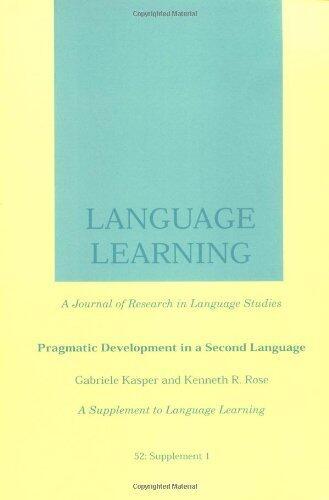
Description
This insightful work delves into the intricacies of pragmatic development in second language acquisition. It explores how learners navigate the complexities of using a new language in real-life contexts, emphasizing the importance of social interactions and contextual awareness. The authors provide a thorough examination of how individuals adapt their language use based on cultural norms and communicative expectations.
Through a combination of research findings and practical examples, the text highlights the challenges faced by language learners in mastering pragmatics. It draws attention to the ways learners can develop effective communication strategies and become more adept at understanding implied meanings and social cues.
Overall, this engaging exploration serves as a valuable resource for educators, researchers, and language learners alike, offering insights that can enhance teaching methodologies and improve language acquisition outcomes.
Through a combination of research findings and practical examples, the text highlights the challenges faced by language learners in mastering pragmatics. It draws attention to the ways learners can develop effective communication strategies and become more adept at understanding implied meanings and social cues.
Overall, this engaging exploration serves as a valuable resource for educators, researchers, and language learners alike, offering insights that can enhance teaching methodologies and improve language acquisition outcomes.
Book Details
Format
Paperback
Language
English
Publisher
Wiley-Blackwell