

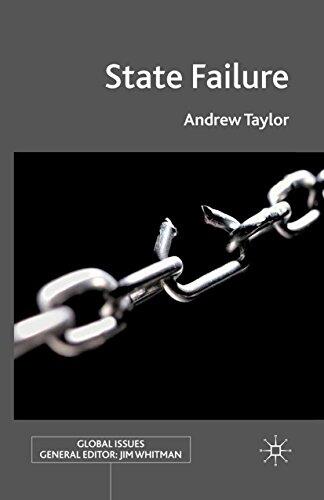
Description
During the 1990s the concept of state failure emerged as
part of an attempt to explain and understand the complex, post-Cold War, new world
dis-order. State failure achieved prominence, being applied to situations of
institutional collapse and mass violence that appeared to herald a new level of
international instability. Ungoverned territories hosted criminal networks,
narco-barons, and terrorists; they would be sources of threats flowing from
environmental degradation and disease. The failed state influenced profoundly
international politics in early-21st century. Exploring critically the emergence,
evolution and consequences of the state failure concept, Andrew Taylor concludes
that despite a superficial plausibility, it lacks sufficient theoretical and
empirical rigour to understand the varying phenomena gathered under the heading of
state failure. This lack of intellectual depth renders it dangerous as a guide to
policy.
part of an attempt to explain and understand the complex, post-Cold War, new world
dis-order. State failure achieved prominence, being applied to situations of
institutional collapse and mass violence that appeared to herald a new level of
international instability. Ungoverned territories hosted criminal networks,
narco-barons, and terrorists; they would be sources of threats flowing from
environmental degradation and disease. The failed state influenced profoundly
international politics in early-21st century. Exploring critically the emergence,
evolution and consequences of the state failure concept, Andrew Taylor concludes
that despite a superficial plausibility, it lacks sufficient theoretical and
empirical rigour to understand the varying phenomena gathered under the heading of
state failure. This lack of intellectual depth renders it dangerous as a guide to
policy.
Book Details
Format
Kindle
Pages
268 pages
Language
English
Published
Dec 4, 2015
Publisher
Palgrave MacMillan
Editions
2 editions