

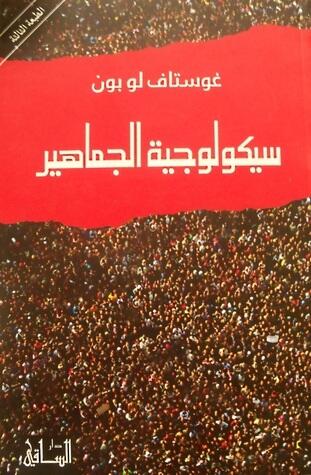
Description
يقدم رؤى تتعلق بكيفية تأثير القادة على الجماهير، وكيف يمكن للتعبيرات والعواطف أن تلعب دوراً محورياً في التأثير على سلوك الأفراد. يتطرق إلى مفاهيم القوة والسيطرة التي يمكن أن تنشأ عندما تتحد الإرادات في إطار جماعي، مما يعكس جانباً مظلماً من الطبيعة البشرية.
بدعمٍ من تحليلات نفسية ودراسات تاريخية، يدعو القارئ للتفكير في كيف يمكن أن يوجه التأثير الجماعي المجتمع، ومدى قدرة الأفراد على المحافظة على هويتهم العقلانية وسط هذه الديناميات.
Book Details
Genres
Reviews
View All
This is an old book that was nearly forgotten for many years. It likely gained renewed notoriety thanks to Sigmund Freud; during his studies on the influence of mass behavior, the psychoanalyst mentioned "The Crowd: A Study of the Popular Mind" by Gustave Le Bon. I particularly enjoyed the first part of the book, specifically the dozen introductory pages where a third person comments on the French writer's personality. This section reveals much about the author’s character: while Le Bon may not have been a womanizer, he was certainly very vain regarding his profession. It is said that on several occasions, when inviting female colleagues or guests to his home for work discussions, he would show them skeletons he kept in the house, claiming they were the remains of his former lovers.
The author argues that the psychology of masses is defined by several characteristics, including impulsivity, irritability, an inability to reason, a lack of judgment and critical thinking, and the exaggeration of sentiments. These are traits that generally do not belong to individuals on their own. According to the line of thought of this anthropologist and psychologist (and, I would add, sociologist), people with a stronger individual temperament could be defined as "Leaders": those with a more powerful personality who possess the ability to influence the mass behavior of others. In simpler terms, Le Bon believes that if a person is placed within a group for a certain period, they will eventually be influenced by it for some unknown reason. Within the group, their personal judgment fails. If irritability prevails within the group, they too become irritable. Similarly, if impulsivity dominates the crowd, the individual soon becomes an impulsive subject.
An important characteristic that Le Bon attributes to crowds is that they are an entity that does not necessarily need to be gathered in the same place at the same time. The psychologist believes that what unites individuals is a sort of "collective soul" acting on a spiritual or unconscious level. Consequently, the worst sides of an individual emerge within a crowd, as the person regresses to primitive forms of irresponsibility and violence.
Gustave Le Bon identifies the causes of this phenomenon through three fundamental mechanisms:
SENSE OF INVINCIBLE POWER: Being immersed in a crowd allows the individual to acquire a sense of extreme strength. Feeling spiritually close to a vast number of people, they tend to yield to instincts that are usually repressed, leading to a loss of their sense of responsibility.
SUGGESTION: Within the crowd, "suggestion" takes hold, reducing the individual to a particular state, almost as if they were hypnotized.
CONTAGION: Feelings and collective suggestions are transmitted from one individual to another by "contagion" (much like infectious diseases).
In his final commentary, Le Bon explains collective behavior as a sort of psychic epidemic, during which individuals are almost forced to imitate the behavior of others based solely on suggestion, a suggestion reinforced by the number of participants. The more people form a group, the greater the certainty of being invincible. The action of the crowd is characterized by instinctivity, as it is completely dominated by the unconscious aspect of the individuals, who lose their critical capacity and allow themselves to be influenced by anything that strikes the imagination, even if it is unrealistic. According to the French writer, words and images exert the most immediate impact: when controlled by a Leader, suggestive words and images have a hypnotizing power born from their vagueness. The more confused and indeterminate the meanings of the terms, the more their power increases.