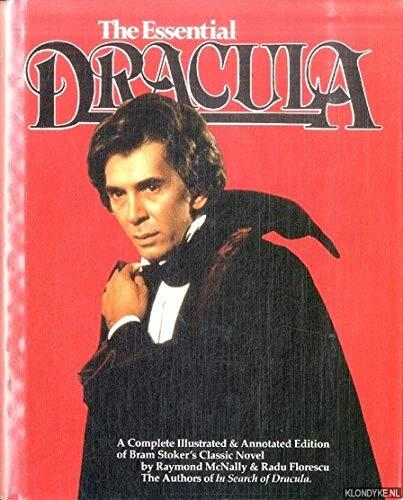
The Essential Dracula: A Completely Illustrated and Annotated Edition of Bram Stoker's Classic Novel

The Essential Dracula: A Completely Illustrated and Annotated Edition of Bram Stoker's Classic Novel

No ratings yet
Jul 27, 1979 · English · Hardcover (320 pages)
Add To Shelf

Rate this book


Export Book Journal

Book Details

Format Hardcover
Pages 320
Language English
Published Jul 27, 1979
Publisher Mayflower Books
Edition First Edition
ISBN-10 0831729937
ISBN-13 9780831729936

Description

Bram Stoker's classic story about the most feared vampire of all time, Count Dracula, is presented here in an illustrated and annotated edition with never before published material taken from Stoker's own notebooks and letters. This edition, with 120 illustrations, filmography, maps and bibliography, is the most completely annotated and informative edition ever published, and has been compiled and introduced by Professors McNally and Florescu, the authors of the best selling In Search of Dracula.

Genres

Romance Mystery Science Fiction Dystopian Thriller & Suspense Young Adult Children’s Biography Action & Adventure Religion & Spirituality Science & Technology History Horror LGBTQ+ Business & Economics Fantasy Manga Graphic Novels Travel Art & Photography Classics Contemporary Paranormal Nature

Reviews

View All

Dracula remains, today, a cornerstone of gothic-horror literature. Bram Stoker successfully created a novel that invokes as much a physical horror as a psychological one.

The most successful element, in my view, of this novel is the atmosphere. It dark, eerie and fully realised in all locations in which we are taken to. The opening section at Dracula's Castle was sublime, a masterclass in introducing a character and his machinations.

Whilst it does slow in the early-middle section of the Novel, its not enough to detract from what is, otherwise, a masterpiece of world building and storytelling.

April 24th 2026

Adoro a dracula

February 27th 2026

One of the books I am extremely fond of and could reread over and over again! This is a classic in the world of horror fiction. Although not the first tale alluding to Vampirism or making of it the center of the plot, it is the one which instilled the genre for over a century now. Ever since Dracula, most -not to say all- vampire stories have one or more of the features of that fearful Transylvanian count in the bearing, appearance, designs, or behavior of their characters.The novel, however, is not merely a horror tale with a somewhat Gothic and monstrous antagonist at its center. It is also a study in the socio-historical conditions of the era. Its plot, by means of illustration, provides a series of contrasts between old traditions and new ideals, scientific rationality versus folklore, and the superstitious old Europe against Modern London. The book supplies numerous references to the latest ideas and inventions of the time in order to reflect the rapid technological changes during the late Victorian period. These references cover phonographs, kodak cameras, portable typewriters, and telegrams in addition to the new medical and psychological theories. Moreover, the entire plot of the novel is presented in the form of letters, diary entries, and newspapers cuttings to convey the scientifically advanced method of observing, analyzing, and recording information. Side by side with this revolutionary rise of science, Stocker appeals to the religious faith in dealing with the supernatural monster in an attempt to revive the religious zeal in an age mostly dominated by secularism. In keeping with the Fin-de-siècle Renaissance of Gothic literature, the book plays on the fears of the late Victorian society especially in connection with the fear of moral degeneration caused by Darwin's theory of evolution. At the same time, the foreign origin of the count can be read as an allegorical representation of the anxiety related to immigration at the time. Immigrants were then closely linked to vice, disease, and corruption. All three can be found in Dracula who's presence in London contaminates everyone with a strain of Vampirism. The two female characters in the novel serve an even more important feat which Stocker had attempted to accomplish. Mina Murray, on the one hand, escapes the preying of the fearful monster by dint of her traditional virtues as "the angel in the house". Lucy Westenra, on the other hand, falls victim to her own unconventional desires and needs as a "new woman". This portrayal suggests to the mind Stocker's possible opposition to the new woman and his preference of conventions. Overall, the book is a classic scare. It is dark, creepy, suspenseful, and interesting, which would allow its enjoyment by many more generations to come.

February 17th 2026
Add To Shelf

Rate this book


Export Book Journal